
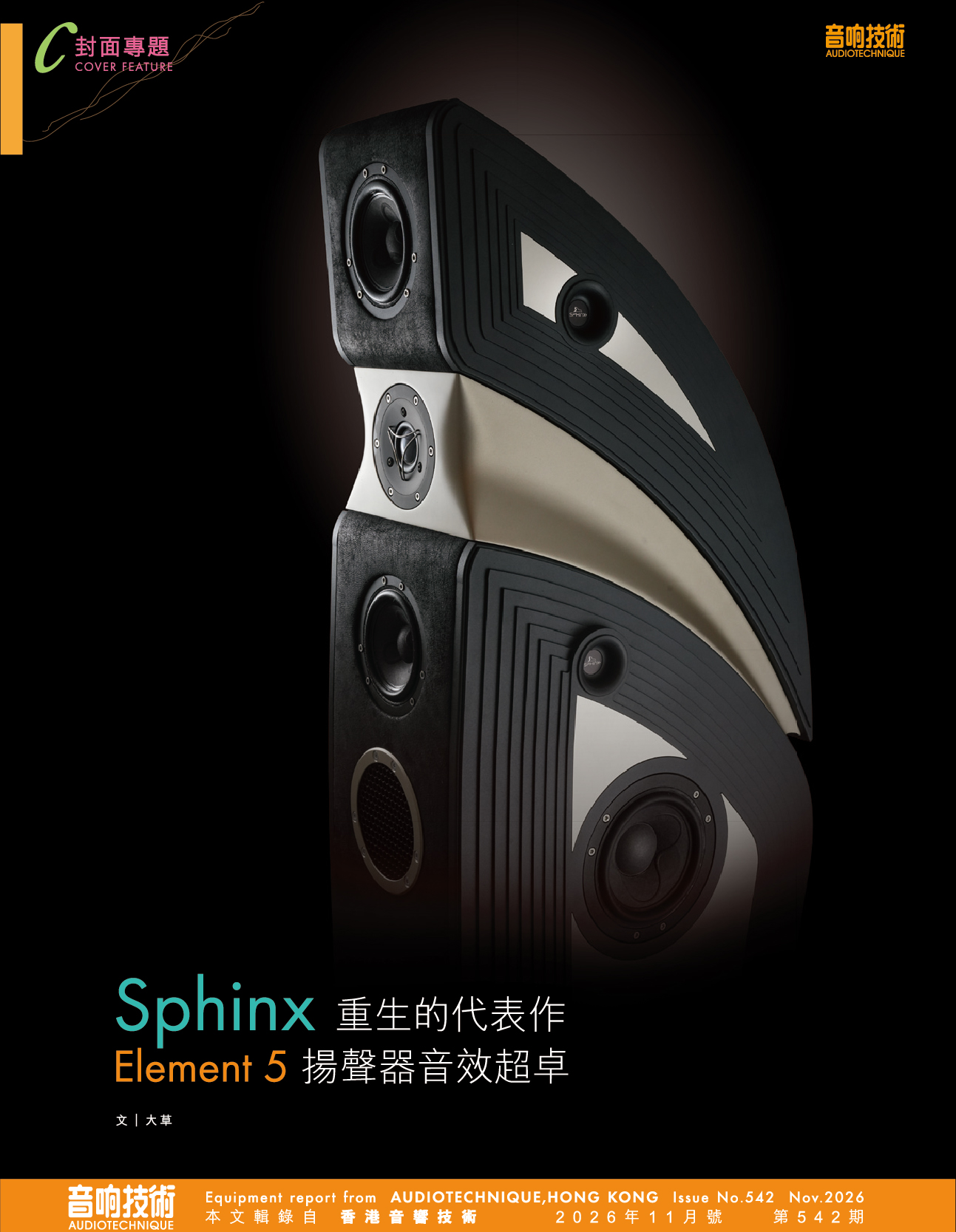
Review in Audiotechnique|Element 5, the landmark speaker marking Sphinx’s rebirth, delivers outstanding sound performance
After reading this lengthy review of the Sphinx Element 5 by Da Cao, editor-in-chief of Audiotechnique, the first thought that comes to mind is not a specific technical parameter, but the word “rebirth”. The Sphinx brand, bearing the Sphinx logo, traces its origins back to when Edwin van der Kley-Rynveld, owner of the Dutch Siltech Group, designed amplifiers. It was sold in 1995 and then faded into silence in 2003 following its distributor’s closure. Now reborn as a new brand under the Siltech Group, its history itself reads like a cycle tale in the audiophile community. The Element 5 is far more than a new pair of speakers; it represents a fusion of the brand’s heritage and cutting-edge technology.
What impresses me most about this review is that it does not frame the Element 5 merely as a product built by stacking premium components. Instead, it repeatedly emphasizes the integrated philosophy behind its design. Its specifications include a three-way, five-driver configuration, Scan-Speak Illuminator midrange and bass drivers, SB Acoustics Satori tweeters, a D’Appolito layout, and dual side-firing bass drivers. Judging by these figures alone, it would be hard to imagine how the speaker sounds. But when reading about the dual transmission ports of Zero Gravity Bass™, the isolated midrange chamber, CNC-machined laminate panels, aluminum side panels and enamel coating, alongside its inductor-free, fully balanced active auxiliary crossover, it becomes clear that the Element 5’s uniqueness stems not from one single trick, but from the synergy of its cabinet, drivers, crossover and active circuitry. The PACTM technology, in particular, combines the crossover with a buffer amplifier, easing the load on the user’s amplifier while avoiding coloration and dynamic compression caused by large inductors. This design approach is highly compelling.
I was especially struck by its 16-ohm impedance and 95dB sensitivity. Many audiophiles tend to judge a speaker’s merit by how hard it is to drive, yet the Element 5 takes the opposite path. It allows most solid-state and tube amplifiers to operate more easily under a 16-ohm load, with lower distortion and less heat generation. This is not a compromise, but a redefinition of system-matching freedom. Users do not have to chase excessive power output; instead, they can invest resources in amplifier quality. The review’s remark that it “prioritizes quality over brute force” is well worth pondering.
On the subject of sound performance, two other editors, Joey and Chung Kai Yuen, offer perspectives that build a more complete portrait of the Element 5. Joey tested it with Eason Chan’s 《時代曲》, RCA’s 《Masquerade Suite》, and Black String’s 《Dang, Dang, Dang》, documenting its focused vocal presentation, soundstage depth, lustrous string timbre and snappy bass transients. Chung Kai Yuen evaluated its large-scale dynamics and low-frequency energy with Linda Rondstadt’s 《What’s New》 and 《The Great Gate of Kiev》from Pictures at an Exhibition. Both reviewers note that the Element 5’s bass performance exceeds the physical expectations of its 150mm bass drivers — it is fast, clean and punchy, which is exactly what makes the Zero Gravity Bass™ and back-to-back bass arrangement so intriguing. Even without listening in person, readers can roughly grasp the character of these speakers from descriptions such as “subtle tension in the vibrating drumhead”, “overwhelming energy”, “inky black background”, and “three-dimensional, well-defined imaging”.
The review lays out a clear logic: the Element 5’s innovations are not intended for novelty’s sake, but are built around the goals of transparency, zero coloration, low amplifier load and exceptional control. From the harp-inspired silhouette and Sphinx brand imagery to its isolated internal chambers and transmission-line architecture, the speaker exhibits a craftsman-like attention to detail both inside and out.
Overall, this review shows how a legacy brand can stage a comeback with new technology, and prompts me to rethink the value of high-end loudspeakers. What truly commands a premium is not just the drivers and cabinet, but the designer’s meticulous calculation of the sonic signature, and the patience to let music flow naturally. Whether the Sphinx Element 5 will go on to become a classic remains to be seen, yet I have gained genuine respect for this reborn Sphinx.