

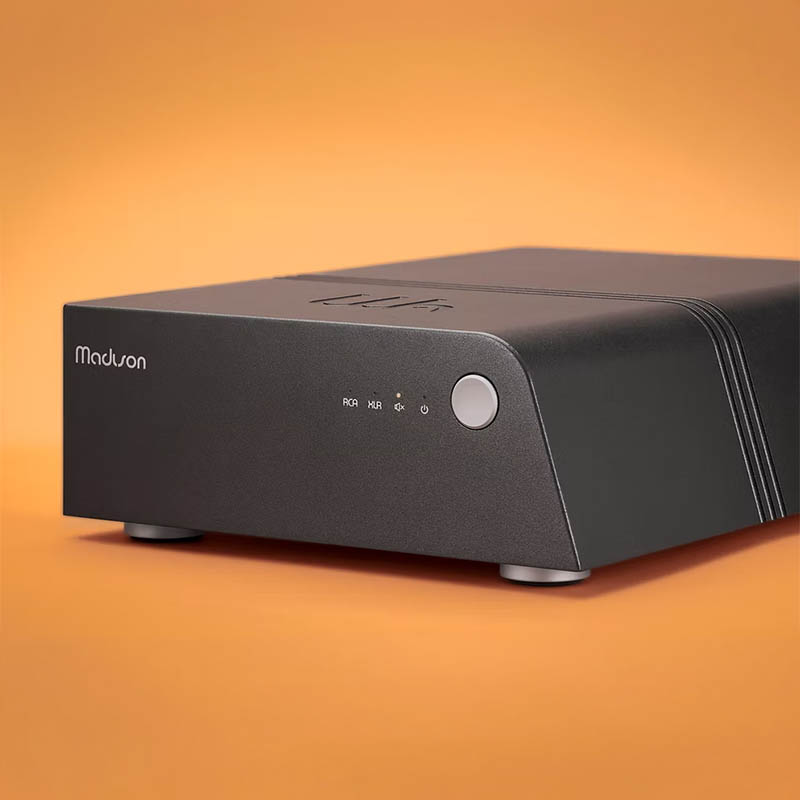


Madison Amplifier
The Madison AMPLIFIER pioneers a new approach to high-end amplification, combining innovative architecture, precision engineering, and harmonic integrity to deliver a deeply immersive musical experience.
A Design Collaboration with CH Precision
The Madison Amplifier was developed through direct engineering collaboration between Wattson and CH Precision. That collaboration shaped the amplifier where it matters most: topology power strategy device selection and overall circuit behavior. The result is a compact amplifier built with real structural seriousness. It applies lessons from CH Precision’s engineering culture to a more accessible platform without turning that relationship into theater.

The Madison Amplifier combines a low-feedback Class A/B linear circuit a robust regulated and highly filtered power supply and a fully symmetrical discrete amplification stage in a compact form. Its design reflects Wattson’s broader discipline: modern high-density circuitry carefully integrated and optimized for speed stability and musical engagement.
Its compact architecture is part of the amplifier’s character. It allows Madison to deliver articulate dynamic performance across a wide range of loads while remaining configurable for different systems and requirements.

A Power Supply Designed as an Instrument
The Madison Amplifier is built around a balanced regulated and filtered external switch-mode power supply with high current capacity. That supply is fundamental to the amplifier’s performance establishing the stability dynamic authority and composure that allow Madison to remain articulate across changing loudspeaker loads.
The Madison Amplifier power supply is treated as an integral part of the design supporting the amplifier’s speed composure and musical engagement rather than merely satisfying a specification.
Balanced (XLR) and single-ended (RCA) inputs allow the Madison Amplifier to integrate easily into a wide range of systems. From the input stage onward the circuit remains fully symmetrical and fully discrete preserving the amplifier’s structural consistency whether the incoming signal is balanced or unbalanced.
This underlying design shapes the Madison Amplifier’s essential character: fast dynamic and stable under load. It also gives the amplifier the configurability and adaptability to work effectively across a wide range of systems and installation contexts.

System Architecture: Scalable by Design
The Madison Amplifier supports Stereo Mono and Bi-Amp operation. Those modes allow it to adapt to different loudspeakers and different system requirements without changing its underlying design. In stereo operation Madison functions as a compact two-channel amplifier. In mono operation a single chassis is assigned to one channel increasing available output power into lower impedances. In bi-amp operation both channels can be directed to separate driver sections of a compatible loudspeaker system. This flexibility gives the amplifier a longer useful life as the system evolves.

Discrete Architecture: The Foundation of Continuity
Madison’s amplification stage is built around components derived from reference-grade designs developed with CH Precision. At its core are the same bipolar output devices used in the M10 Reference Amplifier implemented here as one device per rail. These devices give the output stage a foundation proven at the highest level.
The ultra-high quality of the parts ensures predictable electrical behavior under temperature variations and dynamic demand. Bias stability reduces crossover distortion and controlled feedback sustains linear gain while preserving harmonic nuance. Stability in the circuit translates directly into coherence in musical phrasing: tonal structures remain intact from soft passages through peak dynamics and instrumental texture persists under load.

General
- Type: 2-channel power amplifier
- Modes: Stereo, monaural, bi-amp
- Color Options: Light gray or dark grey
- Dimensions (W x D x H): 216 x 300 x 87 mm
- Weight: 6.0 kg
- Power Supply: External 36V DC, 350 W, universal input
- Power Consumption: < 0.5 W standby, 20 W idle, 450 W max
User interface
- Mode, Impedance, and gain: Toggle switches on the rear side
- Input, Mute, Standby / ON: Push button on the front side
- Firmware update: Via Ethernet connection
Analog input
- Type: Balanced XLR, single-ended RCA
- Impedance: 100 kΩ
- Nominal level: 2.0 V RMS
Analog Output
- Type: Spade / Banana sockets
- Bandwidth: 1 Hz to 400 kHz (-3 dB)
- Total Harmonic Distortion + Noise: < 0.05 %
- Signal-to-noise ratio (A-weighted): > 120 dB
- Voltage gain: +20 dB, +26 dB (switchable)
Output Power
Stereo / bi-amp:
- 8 Ω : 2 x 50 W
- 4 Ω : 2 x 75 W
- 2 Ω : 2 x 100 W
Mono:
- 8 Ω : 1 x 50 W
- 4 Ω : 1 x 100 W
- 2 Ω : 1 x 150 W