
1
2
3
4

5

6

7

8

9
Stereophile Review|Unison Research S6 Black Edition integrated amplifier
Celebrated for its contributions to cuisine, music, and art, Italy boasts a rich cultural heritage and a history of profound significance to the world.
From the 1088 establishment of the University of Bologna, the oldest university in the Western world, to the invention of the radio by Guglielmo Marconi in the mid-1890s, Italy has been at the forefront of innovation and artistic pursuit. Modern Italy stands as a testament to its vibrant past.
“The Italian Renaissance, which began in Florence in the 1380s, marks the first moment when Europeans stepped away from the traditional and medieval pious Christian view of man to embrace values and attitudes they had discovered through studying the culture of the ancient world,” wrote William (“Bill”) Adams, a former professor of Italian history, in an email. “Those values, belief in the dignity and worth of man, in human development through education which, having spread through Europe, led to the Scientific Revolution and the Enlightenment.”
In 1996, Bill and I journeyed to Tuscany, where we stayed in a mountaintop castle nestled within the ancient walls of San Gimignano. Returning to Italy in the summer of 2024, I embarked on a tour with kindred spirits. Our travels took us from savoring perfectly al dente pasta in Rome to indulging in boot-sized portions of tiramisu in Tuscany. We also ventured into the Treviso countryside, where we toured the Unison Research (UR) factory. This is where I had my first exposure to Unison Research’s S6 Black Edition Integrated Amplifier.
But before we get into the blood and guts of this review, some Unison history.
Founded in 1987 by Giovanni Maria Sacchetti, Unison Research shares a facility with Opera Loudspeakers, founded by Giovanni Nasta. The two companies have close ties: Riccardo Nasta, Unison Research’s production manager and Giovanni’s figlio (son—I looked it up), contributes to the fine-tuning of Opera’s loudspeakers. Bartolomeo Nasta, managing director of both companies and Giovanni’s altro figlio, patiently answered my questions about the S6.
In their Treviso shop, Unison Research crafts audio equipment with a dedicated team of 11 specialists supported by three external engineers. The company’s staff is rounded out by a social media manager, a marketing and automotive manager, and an external digital team. Among UR’s most sought-after offerings are its Simply Italy amplifiers and the complete Unico line, including the Unico Primo integrated amplifier, which I reviewed in 2016.
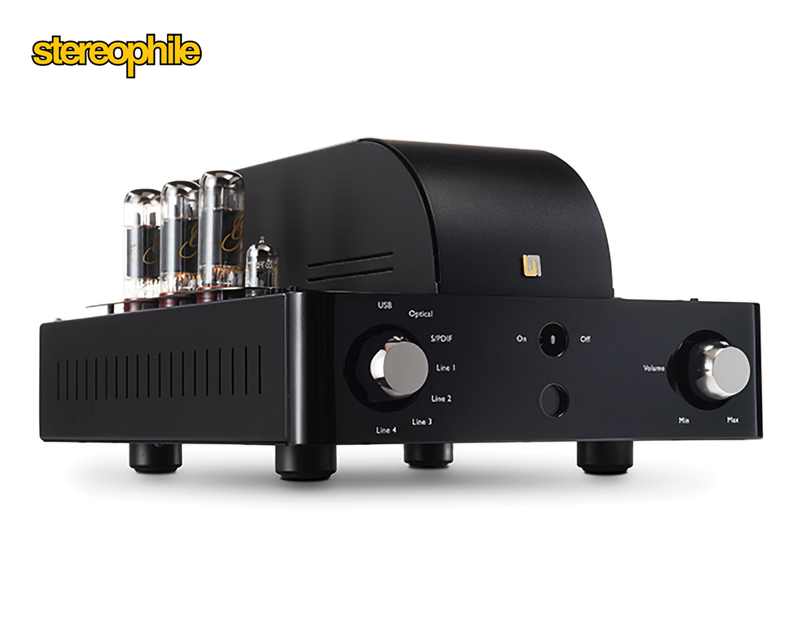
Introduced at High End Munich 2024, the S6 Black Edition is a single-ended design, its three KT77 tubes per channel are connected in parallel, operating in a class-A, Ultralinear configuration. The amp’s output transformer, comprised of seven winding sections, is designed for maximum power transfer into an impedance of 6 ohms.
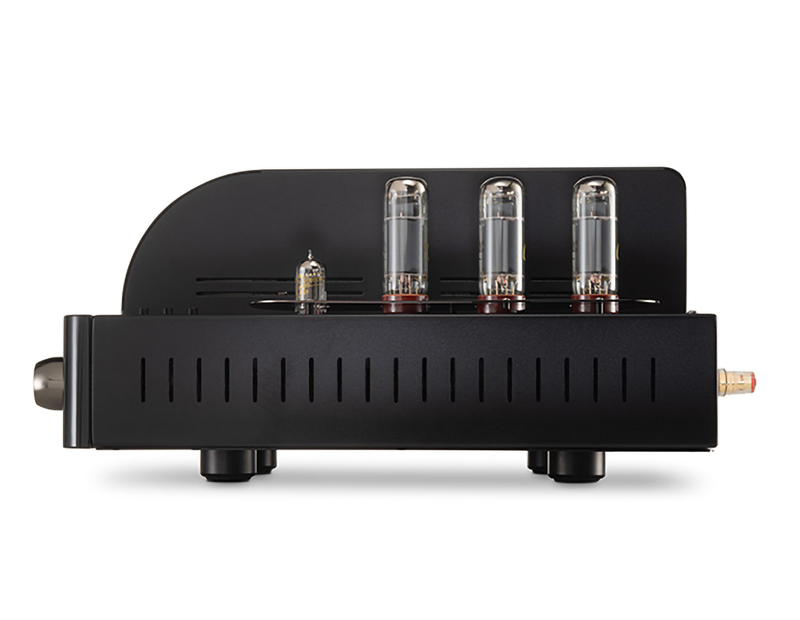
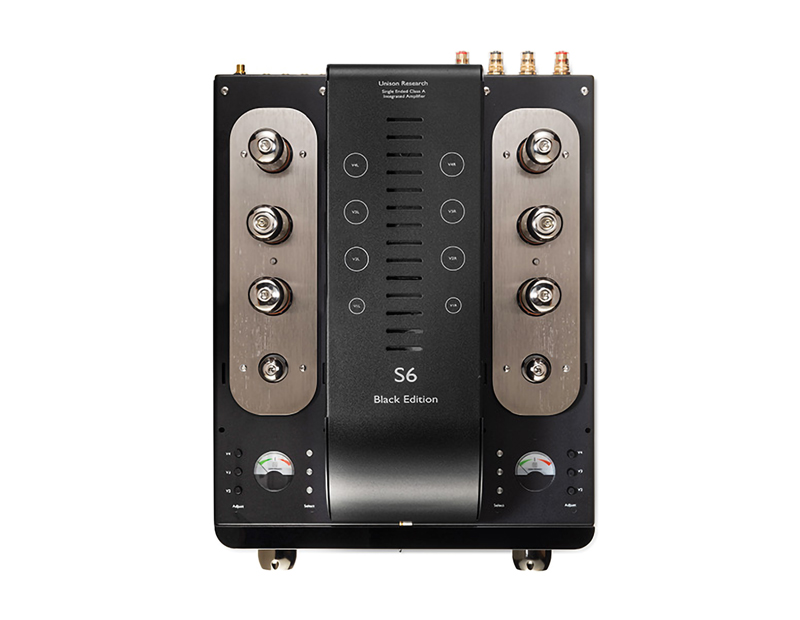
The original S6 uses EL34 power tubes, each channel of the S6 Black Edition employs three Genelex Gold Lion KT77 tubes to generate 40Wpc (specified at 5% THD), driven by a Genelex Gold Lion 12AX7/ECC83 dual-triode tube. The S6 Black Edition stands 13.75″ wide, 17″ deep, and 8″ high. It weighs 55lb. Upholding Italian tradtion, the S6 Black Edition is gracefully appointed, its curved transformer cover giving it a streamlined Moderne sheen. Its two large stainless steel control knobs are curvaceous and eye-catching.
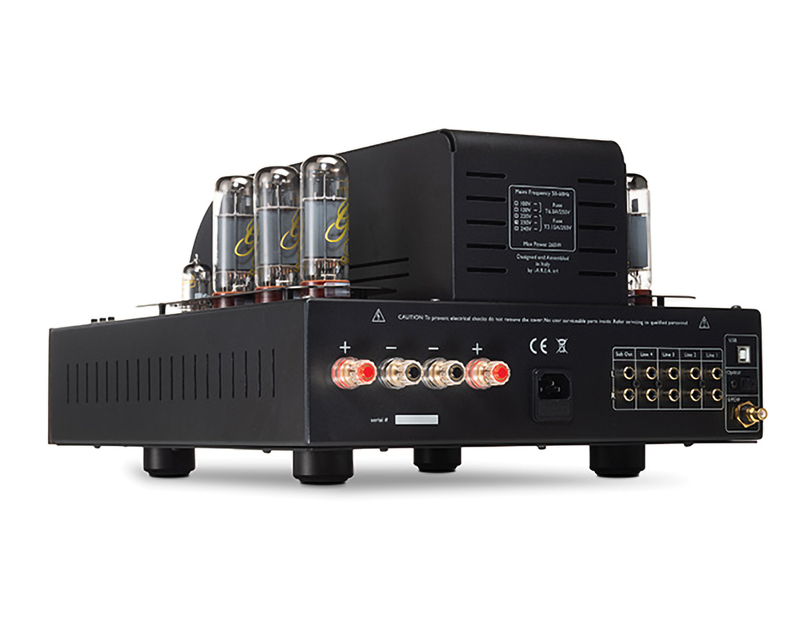
The bias meters, RCA jacks, and speaker binding posts are manufactured in Asia, but the bulk of the S6 Black Edition’s parts are made in Italy, including its case, bottom, and top plates—all powder-coated iron. Its MDF control panel is finished in piano-black lacquer, tube bases are ceramic with gold-plated contacts, and the aforementioned knobs are brushed stainless steel. The tube grilles and stainless steel plates that surround the tubes are plated with black nickel. The feet are black anodized aluminum with rubber bases. The remote control is wrapped in a milled cherry case with an aluminum control panel with laser-engraved text.
The S6 Black Edition is dual-mono, partly hard-wired, partly PCB, with separate left- and right-channel circuit boards. Electrolytic capacitors inside the S6’s anode power supply carry recognizable brand names: Rubycon, Nichicon, Nippon Chemicon. In the Black Edition, Nasta wrote, “strategically placed polypropylene capacitors have been added to the power supply, improving transient response and signal dynamics.” The power supply has also been enhanced by decoupling the anode voltage of each tube to ensure their independence.
Polypropylene caps in the signal path also have recognizable brand names: Mundorf, Wima, TDK.
All three transformers utilize ferrosilicon laminates, thin layers of iron-silicon alloy stacked and bonded together. “Power and output transformers are of our own design, manufactured under our strict specifications by an Italian manufacturer,” Bartolomeo Nasta wrote over email. “Power transformers are resin-potted to prevent vibration and to better dissipate heat.”
The first amplification stage is feedback-free, and there is no global feedback. Feedback is utilized on the second triode—the second amplification stage. This feedback “allows more control of power delivery to the speakers without altering the musicality of the amplifier.”
The S6 Black Edition uses “ionic polarization” for the first signal triode, an approach Unison Research has been refining for decades. “This polarization, coupled with the absence of global feedback, results in improved micro-detail and a natural dynamic sound,” the UR website says. Nasta added in an email that this ensures a “detailed, fast sound combined with very low distortion with very natural harmonic decay, similar to that of a musical instrument.”
The original S6 used an autobias system for the power tubes; a user-friendly biasing system has been introduced in the Black Edition. The first model used ECC82s as signal tubes; these have been replaced with 12AX7/ECC83s. The circuit boards have been upgraded.
“The input selection circuit has been meticulously redesigned using microrelays with gold-plated silver contacts to ensure stable contact and to prevent crosstalk with other nonselected sources connected to the amplifier,” he added. “The return grounds of the inputs have been implemented using Return GND technology. The signal not in use is enclosed in a small path and confined near the RCA connectors. Service power supplies in the Black Edition are individual for each electrical load so that there is no interference in sound between the various parts of the device.”
“For the input selector, we used the same approach as in our Reference and Absolute amps,” Nasta wrote. Armored relays with gold-plated silver contacts are used to switch inputs; these are manufactured by Fujitsu. “Signal selection by relay allows greater separation between channels. The signal to the unused inputs is closed on a load resistor near the input itself through a special return ground. As a result, the inputs not in use (signal and ground) don’t interfere with the audio signal, and the signal doesn’t propagate through the boards. The same principle is applied between the right and left channels so that they are as independent and isolated from each other as possible so as not to lose detail.”
Sacchetti, Nasta, and their team meticulously refined the S6 Black Edition’s design to minimize noise. Their efforts included optimizing (in addition to the input selector) signal paths, board placement of components, and cabling. On-board components were strategically shielded to mitigate the influence of magnetic fields emanating from the transformers and power supplies. These enhancements are said to result in a lower noisefloor, increased output power, and, consequently, greater dynamic range.
“The S6 Black Edition was created to exceed the musical performance of the standard S6 version,” Nasta told me in an email. “Compared to the standard S6, we gained more power, better sonic detail, and the lowest possible noisefloor. “In general, when we design an amplifier, we look for instrumental and musical performance as sound scene reconstruction. We try to recreate a sound event as close to reality as possible, without artifice, that can be listened to for the long term. All with a touch of Italian design.”
So far, this all sounds sophisticated but analog-purist: old school. But that’s not the whole picture: The S6 Black has a built-in DAC. The “DAC3” module uses a Sabre ES9018K2M DAC chip. Inputs include USB (supporting PCM up to 384kHz and DSD to DSD256), TosLink, and S/PDIF.
Setup
To isolate the amp from resonance nasties and rowdy FedEx trucks rumbling down my well-worn Greenwich Village block, I placed an Aptitlig bamboo cutting board underneath the S6 Black Edition. This, along with Norman Varney’s EVPs (the best isolation pucks I’ve found for resonance control and noise reduction) placed under the Aptitlig, provided vibration isolation. To evaluate the S6 Black’s internal DAC, I connected my Tascam CD 200iL CD player via a single Triode Wire Labs Spirit RCA cable running from the CD player’s coax output to the S6’s S/PDIF input.
Biasing the KT77 tubes was quick and easy. Simply press the small metal button for the corresponding KT77, then use the opposing knob to adjust the needle within the bias window until it’s as close to the center as possible. Throughout the review period, I periodically checked the bias, and it remained remarkably stable.
Listening
Inspired by the YouTube channel Poetry on Plastic, I’ve recently been immersing myself in classical recordings on vinyl. A visit to VPI House in New Jersey, where Stereophile Managing Editor Mark Henninger and I interviewed VPI’s Mat and Harry Weisfeld for the Stereophile Icons series, proved particularly fruitful. Harry shared a box of original Mercury Living Presence LPs, setting me on a path of sonic discovery and emotional overload.
The S6 Black Edition paired with the Volti Audio Lucera loudspeakers took to classical music as if to the manor born. True to its artistic heritage and legacy, the S6 served up a musical meal full of color, drama, and intensity.
The S6 Black presented Rimsky-Korsakov’s Scheherazade, performed by the Minneapolis Symphony Orchestra under Antal Dorati (Mercury SR90195), with striking clarity. The performance showcased natural reed tone, rich violin and harp, and generally a captivating sense of immersion, this last quality a consistent hallmark of the S6. The music it made possessed a deep, dark-chocolatey richness while managing to avoid cloying sweetness or sentimentality. Its presentation was vibrant and full. The S6 expertly laid out the nuances of the Minneapolis Symphony with excellent layering and separation. During the opening, “The Sea and Sinbad’s Ship,” the S6 captured the music’s surging intensity; the orchestra rose like a rogue wave, threatening total submersion in sound.
The S6 Black handled Respighi’s The Birds, performed by the London Symphony Orchestra and also conducted by Dorati (Mercury SR90153), with similar aplomb. The Prelude is a brutal test of dynamics; the orchestra explodes from the first note. The S6 Black met this challenge, delivering a thrilling wall of sound without a hint of strain. The presentation was sweet and tuneful, rhythmically powerful, and dynamically graceful, swinging effortlessly yet compellingly from ppp to fff—power with finesse, rich texture, thrilling dynamics, all within a big soundstage with instrumental sections well delineated.
On Dorati’s Conducts Wagner (Mercury SR90234), the swaying strings bristled with intensity and liveliness; they were never coarse. The S6 Black was a time machine and tone generator; the result was color, drama, and intense visceral impact.
Voxativ Ampeggio 2024
Navigating large floorstanding speakers in my cramped NYC apartment is a challenge, especially with records piled high in every corner.
I replaced the Luceras with the Voxativ Ampeggio 2024 speakers, starting with the Ampeggios close to where the Luceras had been located; only minor adjustments were needed to get the sound I knew the Voxativs were capable of. The Voxativ Ampeggio 2024s are slightly less sensitive yet still very sensitive—a light load even for a low-power amplifier; the S6 Black’s 40Wpc, specified into 6 ohms, should be ample.
Moving beyond classical but sticking to vinyl records, I played jazz from Count Basie, Anne Butterss, Steve Coleman, Dave Holland, and Bob Dorough. All shone through the S6 Black, leaving me wanting nothing except more of the same.
I mounted the Ortofon 2M LVB 50 moving magnet cartridge on my Korf TA-SF9R tonearm, which was attached to the armboard of my Thorens TD 124. The Ampeggio’s laserlike focus created a different synergy than I’d heard with the Luceras. The upper treble lacked some of the ease I heard with the Voltis, but the music remained effortless and flowing, and the Ortofon/Unison Research/Voxativ pairing compensated with extra drive and emotive energy. The music was vibrant and intense, like a winter sunrise.
Another cartridge swap, Ortofon 2M LVB 50 to Kuzma CAR-30 MC. This change transformed the sound. Music became more sensuous, atmospheric, sweet. Listening to the Great Jazz Trio’s Re-Visited (Eastworld EWJ-90005) or Kraftwerk’s Tour de France (Kling Klang 50999 9 66109 16), the presentation became more glider-smooth, less bullet-train powerful, more silken. No matter what I paired it with, the S6 Black, with its signature golden hue and consistent well-sortedness, faithfully reproduced subtleties of the upstream and downstream components.
DeVore Fidelity Super Nine
With upstream components unchanged, I switched from the Voxativ Ampeggios to the DeVore Fidelity Super Nines, which, though still sensitive and an easy load, with a specified nominal impedance of 6 ohms, are less sensitive still than the Voxativs. The Super Nines interacted with my listening room and the S6 Black in entirely new ways, presenting a dramatically different sonic landscape than either the Voxativs or the Voltis.
Sticking with Kraftwerk: Tour de France (side 1) is practically a travelogue in sonic form, and the S6–DeVore pairing gave it the full scenic treatment. The crystalline swooping hi-hats, four-to-the-floor bass-groove generator, and delicate synths melodies shimmered and shook, while the bass drum and sub-bass notes locked onto my room with the tenacity of a tapeworm. I’m pretty sure my neighbors thought I’d installed a car-sized subwoofer.
The Jazz Life (Candid 9019), from 1961, features a who’s who of jazz legends: Mingus! Roach! Dolphy! It’s the jazz equivalent of a royal family reunion with the royal family but with way better solos. Produced by another jazz legend, legendary jazz critic Nat Hentoff, this vinyl artifact isn’t just musically impressive; it’s also a gearhead’s dream. The back cover lists the equipment used in the recording process: Neumann U 47 and RCA 44-BX mikes, a Neumann lathe with a Neumann ES 59 cutter for mono and a Neumann SX 45 cutter for stereo, an Ampex 300 recorder. You can smell the vacuum tubes.
The S6–DeVore pairing rendered The Jazz Life with captivating transparency and charm, and life-affirming flow. From the delicate nuances of Roy Eldridge’s muted trumpet and the crisp articulation of Jo Jones’s ride cymbal to the resonant depths of Charles Mingus’s bass, every sonic texture was exposed with exacting clarity and a touch of romance. The soundstage was broad and deep, the listening immersive. Could I ask for anything more?
I dug out my Tascam CD-200 iL CD player to evaluate the S6’s internal DAC. From vocalist Kristiana Roemer’s House of Mirrors (Sunnyside SSC 1597) to keyboardist Martin Bejerano’s #CubanAmerican (Figgland FR-003) to drummer Duduka Da Fonseca Trio’s Rio Fantasia (Sunnyside SSC 1753), the sound was perfectly fine: quiet, even compelling, but nowhere near as engaging as my analog setup. If you choose to attribute this to my vinyl bias, fine.
To sum up the S6–DeVore combination: While perhaps less fresh-scrubbed than with the other combinations, the sound was more honeyed. Where the Voxativs put forward each musical piece with razor-sharp focus, the DeVores emphasized the big picture, the complete performance, the sum of the parts. With the DeVores, music felt less cerebral, gentler, more expressive. I’m tempted to write romantic. Atmospheric. Again, the S6 Black stepped out of the way, allowing the character of the other components to shine through. All three speakers I tried paired beautifully with the S6 Black Edition but with dramatically different results.
Conclusion
I don’t wish to leave the impression that the Unison Research S6 Black Edition is totally self-effacing—that it totally vanishes into the music. It does have a sound of its own, classic tube sound: liquid, a touch warm, excellent tonal color. It’s not old-fashioned or stodgy, but it’s definitely not sterile. It does what none of the hybrids I’ve reviewed, for all their considerable virtues, can match: sound natural, relaxed, and effortless with both sweetness and exemplary resolution. At the same time, it starkly exposed the character of everything I connected to it. It’s a special amp.
Like the Mastersound 845 I reviewed in the May 2023 issue—also Italian—the S6 Black sounds balanced and plenty fast, with nothing off or unnatural. It drove all my (easy-to-drive) speakers easily. It looks great, and there’s a small but significant bonus: The remote control works from any angle.
From Italy to you, the S6 Black Edition comes highly recommended.
Specifications
Description: Two-channel, tubed class-A, Ultralinear integrated amplifier
Tube complement: six KT77 Gold Lion; two 12AX7/ECC83 Gold Lion
Inputs: four single-ended (RCA), USB, S/PDIF, TosLink
Outputs: Two pairs loudspeaker output terminals, subwoofer (RCA)
Power output: 40Wpc into 6 ohms (14.75dBW) specified at 5% THD
Frequency range: 15Hz–30kHz
THD+N: 0.5% at 1W
Total gain (from line inputs): 35dB
Input impedance: 50k ohms
Max. power consumption: 265VA
Dimensions: 13.75″ (349mm) wide × 17″ (4312mm) deep × 8″ (203mm) high
Weight: 55lb (25kg).
Finish: Black.
Associated Equipment
Analog sources: Thorens TD 124 with Korf TA-SF9R tonearm/HS-A02 Ceramic Headshell. Ortofon 2M LVB 50, Kuzma CAR-30 phono cartridges
Digital source: Tascam CD-200 iL CD player
Preamplifiers: Tavish Audio Design Adagio (phono)
Loudspeakers: DeVore Fidelity Super Nine, Volti Audio Lucera, Voxativ Ampeggio 2024
Cables
Interconnects: AudioQuest Pegasus and Firebird, Triode Wire Labs Spirit II (RCA)
Speaker: AudioQuest William Tell Zero (10′)
AC: AudioQuest NRG Z