
1
2
3
4
5
6
7
8
9
With the exterior of Bauhaus architecture and the soul of the Berlin Philharmonic housed within|the ultimate power amplifier Burmester 159
Excerpted from 《Audio Art》
Every time I test a Burmester product, I can’t help but think of their founder, Dieter Burmester (1946-2015). He was a man who always had a smile on his face (at least, that’s how I always saw him), and he was full of energy. Both the exterior and internal design of his products were done by his own hand. Except for the first product, the 777 preamplifier (launched in July 1977), the appearance of subsequent products followed the Bauhaus architectural style. Combined with the chrome-plated finish, they give the feeling of never looking outdated, even after a hundred years. Did you know? In 2018, Burmester was ranked fourth in a magazine’s luxury goods ranking, the only audio brand to make the list. This shows that its product status is quite far removed from that of ordinary Hi-End audio manufacturers.
Integration with Top-Tier Automobiles
From memory, I’ve visited the Burmester factory four times for interviews, and the location never changed – it’s in an industrial area in Berlin. Each time I went, the factory building remained the same, but the equipment being developed inside was constantly evolving. Over nearly 50 years, I could see that Burmester keeps pace with the times. Starting from only producing amplifiers, they later added speakers, then sources. More astonishingly, they accepted the challenge of creating a bespoke sound system for the Bugatti Veyron hypercar, stepping into the car audio world, and eventually expanded to collaborations with Porsche and Mercedes-Benz. More recently, they’ve partnered with Ferrari to develop a dedicated audio system for their first SUV, the Purosangue, emphasizing harmony with the engine sound. From these actions, you can see that Burmester’s R&D capabilities and ability to expand outward are far superior to those of typical Hi-End manufacturers. As early as the 1990s, Dieter Burmester launched the “Artist Edition” series of amplifiers, which had unique designs and materials, produced in limited quantities, and are now collector’s items.
Custom Collaborations
Back to the main story: Burmester was founded in 1977, and in August 1980, they launched the groundbreaking 808 preamplifier. This preamp has now evolved to its fifth generation, and after 45 years, it still looks cutting-edge. From that time on, modular design, DC coupling, and fully balanced circuitry have been core principles, upheld to this day. In 2006, they began collaborating with Porsche to design dedicated car audio systems, first publicly demonstrated in 2009. That same year, Mercedes-Benz also signed a contract with Burmester to create bespoke car audio systems – I experienced these firsthand during my factory visits.
Over these more than forty years, Burmester’s product range has covered amplifiers, speakers, digital sources, analog turntables, and power conditioners – essentially everything an audiophile might need, which is rare among Hi-End manufacturers. In recent years, they have launched custom series in collaboration with other industries, including a partnership with Robbe & Berking, a German silversmith with over 150 years of history, offering different color options. You can even order speakers and amplifiers painted in the same color as your own car. For example, a complete Reference Line flagship system – including the 257 turntable, 246 preamplifier, 259 power amplifier, and BC150 speakers – was finished in Porsche’s Olive Neo. This entire custom system is not only visually stunning but also extremely rare, destined to become a collector’s item. It has also been imported by the Taiwanese distributor, Extreme Audio.
Four Lines
Currently, Burmester’s products are divided into four lines. The top is the Signature Line, followed by the Reference Line, then the Top Line, and finally the Classic Line. The Signature Line has only two products: one is the 159, and the other is the BC350 speaker. The Reference Line includes the 175 turntable, 069 CD player, 111 Music Center, 077 preamplifier, 808 MK5 preamplifier, 909 MK5 power amplifier, and 218 power amplifier. I won’t list the products in the Top Line and Classic Line here, as there are many.
Launched Seven Years Late
The Burmester 159 monoblock power amplifier is the company’s current flagship. From its model number, 159, it should have been launched in September 2015. However, that time usually refers to the “prototype” debut. The official launch of the 159 was in 2022 – a seven-year delay from announcement to market. What happened?
I don’t know the exact reason for the delay, but I believe it is certainly related to the death of founder Dieter Burmester. He passed away in August 2015. After his death, the company undoubtedly went through a period of adjustment. Moreover, Dieter Burmester was himself an amplifier designer, so his death certainly impacted the subsequent progress of the 159. Nevertheless, a delay of this length – from 2015 to 2022 – probably sets a record in the audio industry, right?
In fact, I didn’t see the 159 at the 2015 Munich High-End show; I first saw it at the 2016 Munich show. Alongside the 159 was the C500 speaker. The C500 later underwent significant modifications and became the BC350, Burmester’s current flagship speaker. The appearance of the 159 has remained exactly as it was shown in 2016, unchanged.
Extremely Powerful Power Supply
When Burmester launched the 159, what astonished people most was its adjustable damping factor (23 steps from 102 to 3895, plus a Fixed setting of 4006), along with truly impressive specifications: each channel weighs 169 kg; each channel outputs 1,200 watts (into 4 ohms); peak power can reach 6,600 watts; continuous current 17A, peak current 72A; and it can handle loads down to 1 ohm.
The 159’s appearance resembles that of the company’s 909 MK5, but they differ in size, weight, and power output. The 159 is a monoblock, weighing 169 kg per channel, outputting 1200 watts (into 4 ohms). The 909 MK5 is a stereo amp weighing 72 kg, outputting 600 watts per channel (into 4 ohms). Looking at the internal architecture, the 909 MK5 is a Class AB stereo amplifier that can be bridged to mono. Theoretically, bridging would quadruple the power output, so a bridged 909 MK5 could theoretically deliver 2,400 watts – more than the 159’s 1,200 watts. However, comparing their weights clearly shows the 159’s power supply is vastly more substantial than the 909 MK5’s. So, don’t think you can just buy a 909 MK5, bridge it, get higher power for less money, and come out ahead. The power supply is the heart of any power amplifier, and a stronger heart definitely wins.
Adjustable Damping Factor
What is the innovative idea behind the adjustable damping factor? Why haven’t we seen it on other amplifiers? To understand the 159’s design, we need to understand damping factor calculation. Simply put, damping factor is the load impedance of the speaker divided by the amplifier’s output impedance (ignoring speaker cable resistance for now). For example, if the speaker’s load impedance is 8 ohms and the amplifier’s output impedance is 0.01 ohms, the damping factor is 800 – very high.
What does a high or low damping factor mean? A higher damping factor means better control over the woofer; a lower damping factor means weaker control. How does this sound? With a high damping factor, the bass sounds tighter and cleaner because the driver’s residual vibration is shorter. With a lower damping factor, the residual vibration is longer, sounding warmer and softer. Thus, 159 owners can adjust the damping factor to change the low-frequency character of their speakers.
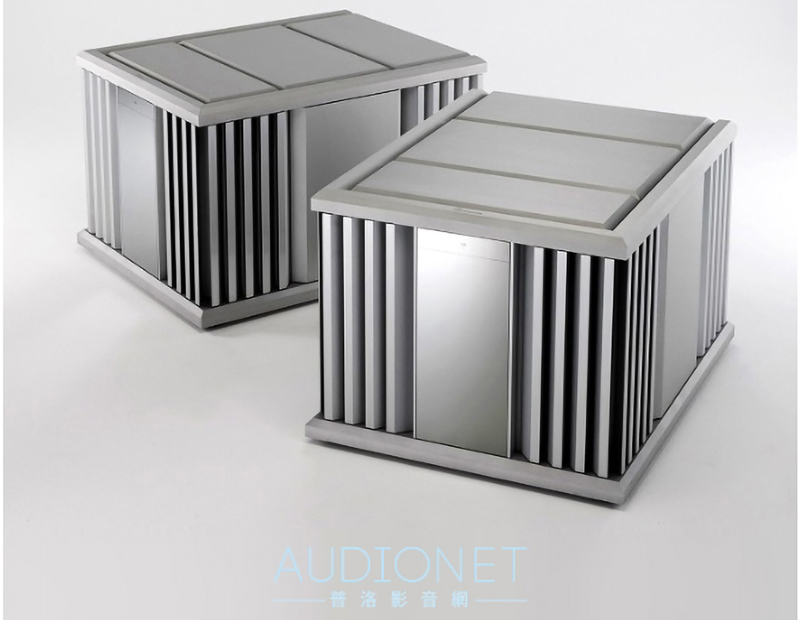
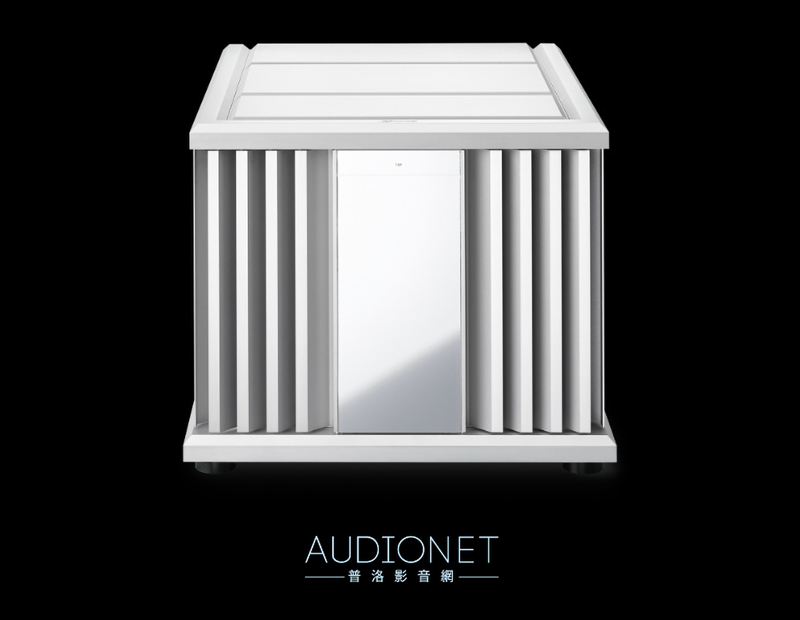
Bauhaus Style
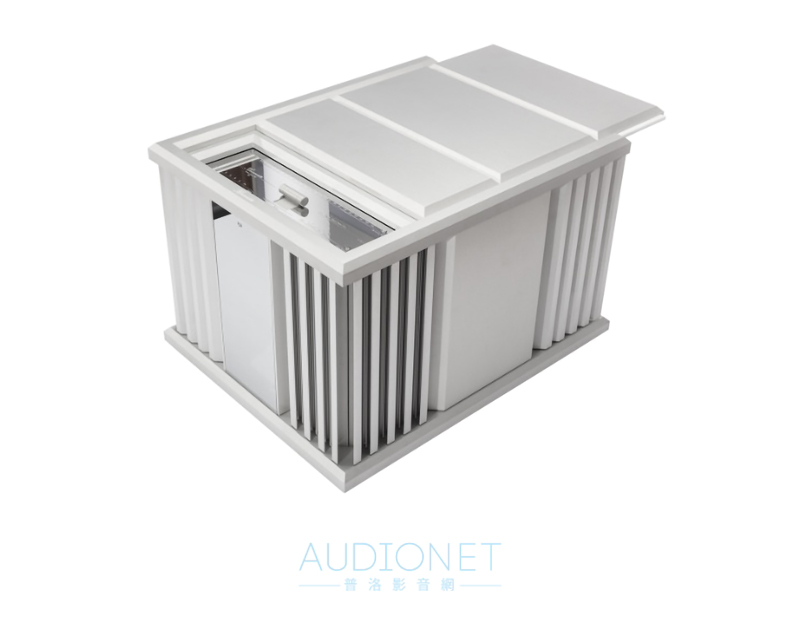
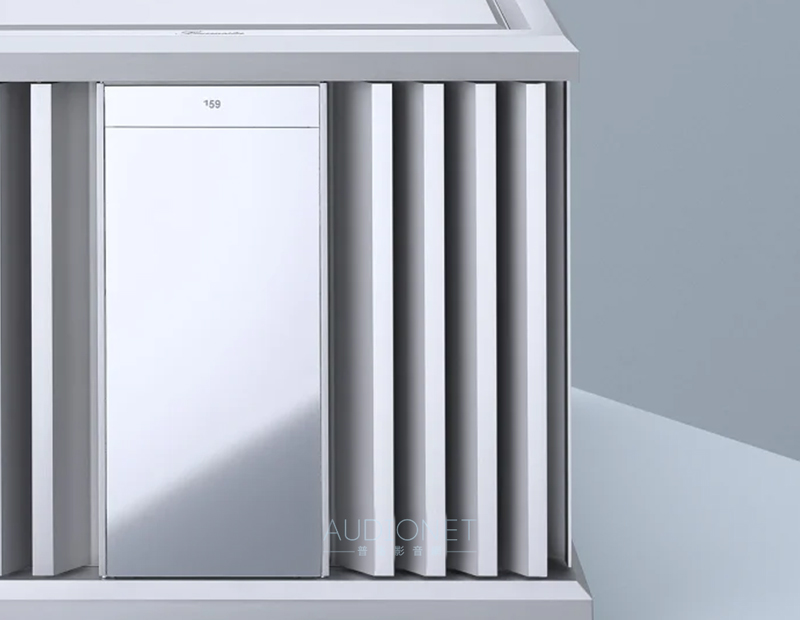
The 159’s exterior embodies the Bauhaus architectural style. The chassis is formed from simple, clean vertical lines, a chrome-plated central panel, and surrounding silver heatsinks. Earlier Burmester products had more chrome plating, but in recent years the chrome area has noticeably shrunk, though the style remains intact. The top cover is made of an ultra-thick 30mm aluminum alloy panel that slides backward to open, revealing a push-rod mechanism for the standby power switch, the damping factor display, along with the Auto Power Down button, BurSync display, and a Sequence display. Honestly, just seeing that ultra-thick, movable top cover commands respect, let alone the internals. To turn on, pull the lever toward you once; to turn off, pull it toward you twice in succession. I’ve never seen a standby design like this before.
Several Special Controls
“Sequence” refers to the internal self-check sequence when powering on. The lights numbered 1-5 will illuminate in order, ending with “On,” indicating normal operation. “BurSync” indicates Burmester’s own synchronization status, used when using two, three, or more 159s. It has four states: Input, Output, Master, and Slave. “Auto Power-down” has four options: Off, Short, Mid, and Long. This determines the automatic shutdown time when no music signal is present. Off, of course, means no auto shutdown; Short means shutdown after a short time, and so on. If you’ve spent so much on a 159, why worry about a little electricity? Set it to Off.
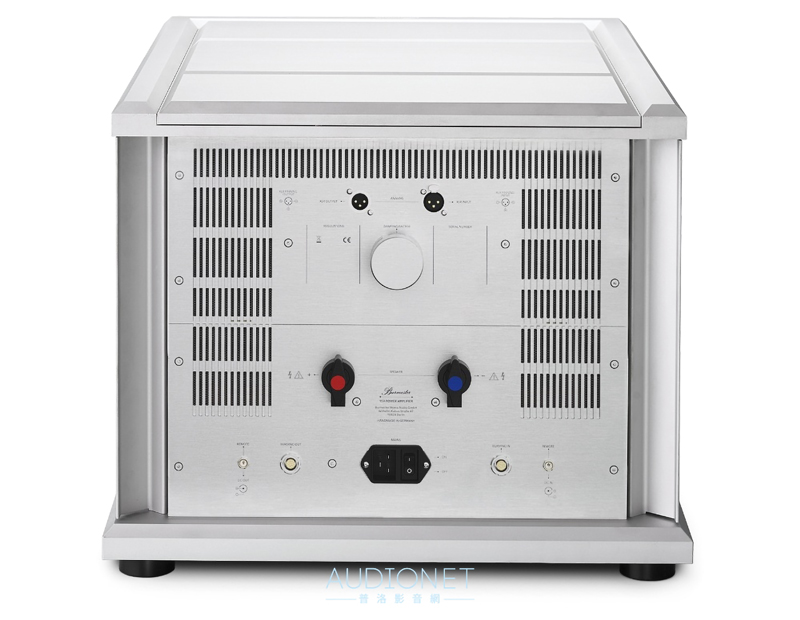
On the rear panel, you’ll find a round damping factor adjustment knob, a set of speaker terminals, and one XLR Input and one XLR Output. Why an Output? It’s for connecting to another 159. There are also BurSync and Remote jacks on the front panel – the former for synchronization connections, the latter for system-linked remote control. Note that this Remote jack on the 159 uses a 10V trigger, not the standard 12V, so it only works with Burmester’s own preamps or other equipment, not with other brands.
Massive 2500VA Transformer
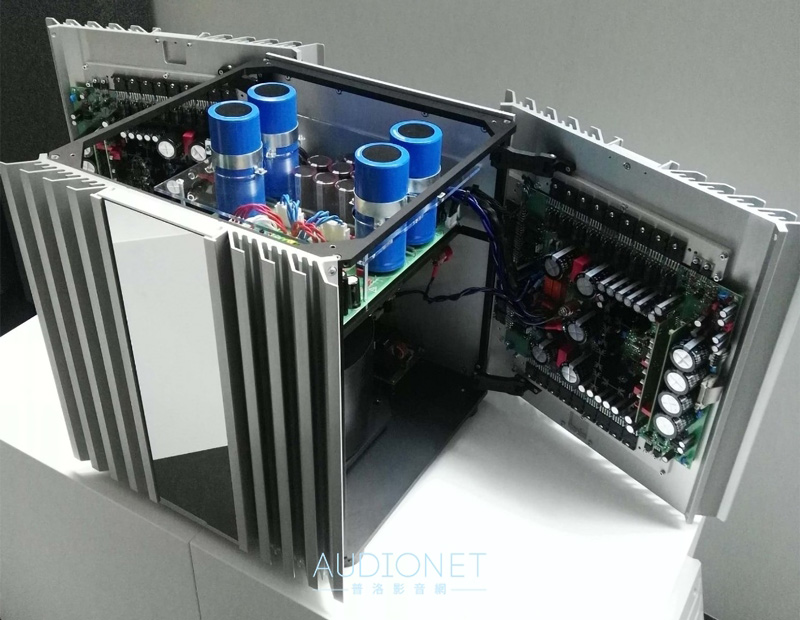
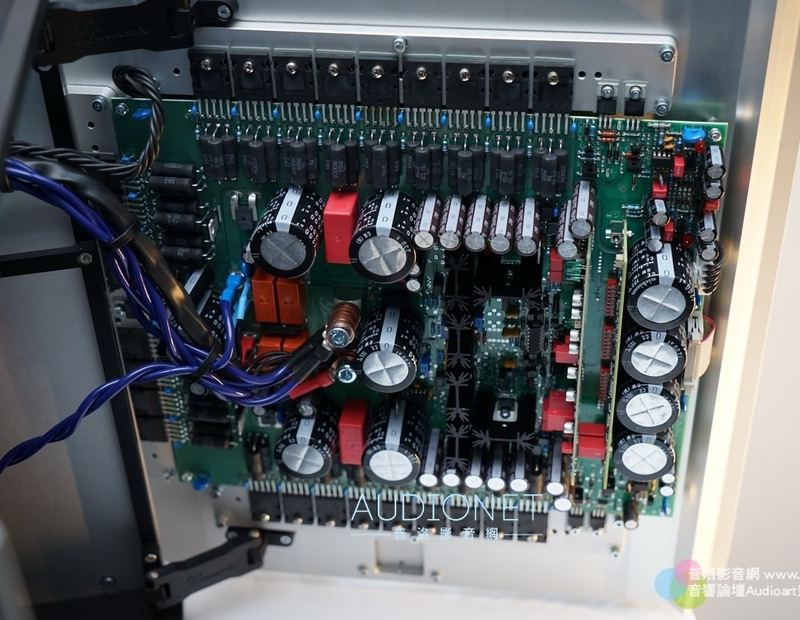
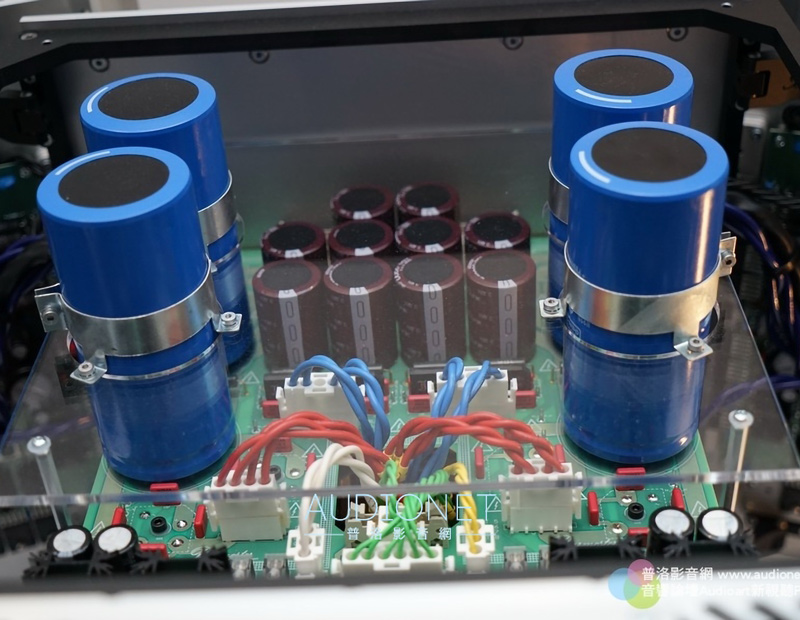
What’s inside the 159 that’s so astonishing? Naturally, I couldn’t disassemble the 159 at home, but I photographed a disassembled unit at the 2016 Munich show, so I know its internal layout. Inside the 159, a massive 2500VA toroidal transformer sits squarely in the center of the bottom. Above the transformer is the power supply rectification and filtering circuitry, with four large filter capacitors standing tall, totaling 200,000 µF. On the left and right sides of the chassis are the power output stages; the entire circuit boards are vertically mounted to the side panels, which are effectively the heatsinks. Each power output stage uses 18 power transistors – though that was the case with the prototype. The final production version might have a different number.
Thorough Protection
The 159’s internal circuit architecture is based on an improved X-Amp, also DC-coupled and fully balanced. There’s also a patented circuit (Sequence) that quickly stabilizes the amplifier, allowing it to sing within seconds of power-up. Given the high power output, there are extensive protection measures, including DC offset monitoring, temperature monitoring, and an analog protection monitoring circuit controlling the power transistors. So, despite the 159’s immense power output, users can rest assured due to the comprehensive protection. It’s important to emphasize that these monitoring/protection circuits are not in the music signal path, so they don’t compromise sound quality.
Listening Environment
My listening session with the 159 took place in my large, open-plan living room. The preamplifier was the 077, a separate power supply model sent by the distributor. My digital source was my Weiss DAC 502 4ch. As for speakers, unfortunately, the distributor couldn’t possibly ship the huge, heavy BC350s to my home. And I don’t own speakers costing millions or tens of millions of NT dollars to pair with it – the most expensive I have is the DynamiKKs! Monitor 10.15, priced at one million NT. So, I had to make do with those.
Tone! Tone! Tone!
Once everything was set up, the moment sound emerged, a wave of pleasure rushed through my brain. I had never heard my DynamiKKs! Monitor 10.15 produce such beautiful, such realistic sound. This one-million NT pair of speakers, now paired with the 159, sounded worth at least five million. Please understand: this is not my first time listening to Burmester amplifiers – I’ve heard all their flagships – so I already had an idea of their beautiful sound. Furthermore, I had already heard the 159’s performance at various venues, including in owners’ homes. But the moment the 159 started playing, I was still utterly captivated.
What captivated me? Tone! Tone! Tone! I have to shout “tone” three times, because as soon as the music played, the supremely beautiful tonal quality of the 159 pierced my ears and mind, delivering an intense sense of pleasure. This is the ultimate value of a power amplifier costing over ten million NT! I listened to many tracks continuously, and the 159 made the DynamiKKs! reveal a beauty of tone I had never heard from them before. Not only that – the music itself became more beautiful. Whether string quartets, symphonies, jazz, or even pop music, the overall musical beauty was elevated significantly. Honestly, with an amplifier like this, what else is there to review? It is beautiful and powerful in every conceivable way.
Losing Flavor
After tasting the 159’s beautiful sound, I almost exclusively used it for listening to music, knowing I would rarely have the chance to enjoy such beauty again. During the review period, due to work, I had to switch to other amplifiers. Amplifiers that previously sounded excellent now felt all wrong, and I didn’t want to continue listening. I should emphasize: my own system is tuned to a very high standard, effortlessly delivering beautiful music and pleasure. But under the “shadow” of the 159, everything changed. It’s like eating a guava – you think it’s sweet. But if you eat a golden diamond pineapple first and then the guava, you’ll definitely find the guava not sweet at all, tasteless. That’s the contrast I experienced. My own system became tasteless. Can you imagine?
Naturally Rendered
Furthermore, I found that the soundstage depth, layering, and imaging reproduced by the 159 seemed naturally rendered, as if perfectly recreating the soundstage crafted by the recording engineer. Everything appeared suffused with a brilliance and brightness, as if viewing through a Leica camera lens. If you’ve ever used a Leica, you’ll know exactly what I mean. If you haven’t used a Leica, you’ll have to rely on your imagination.
For example, listening to John Williams conducting the Vienna Philharmonic in “Excerpts,” a very delicate piece with a wide dynamic range, without accurate instrumental texture, some parts can sound like electronic instruments, though they are all acoustic. Moreover, the orchestral layers seemed completely pulled apart; all the quietly playing, complex inner voices were highlighted, as if viewed through a magnifying glass.
Another example: listening to Curzon playing Beethoven’s “Piano Concerto No. 5” (Hans Knappertsbusch conducting the Vienna Philharmonic), the soundstage layers instantly opened up and expanded. More musical details emerged, the overall soundstage transparency improved, the delicacy was better, the piano had more woody tone, and you could feel the notes had elasticity.
Listening again to Christian Ferras playing Brahms’ “Violin Concerto” (Karajan conducting the Vienna Philharmonic). Similarly, this old recording revealed a musical beauty I hadn’t heard before. The entire soundstage was enlarged, the instrumental layers, depth, and imaging were superior, clear and stable – like viewing through a high-quality lens. These musicians recorded such great sound sixty years ago, yet many audiophiles probably hear terrible sound at home and curse the recording engineers – what a narrow view!
Very Sweet, Beautiful Sheen
The 159’s sound is very sweet, with a very beautiful sheen, especially in violin reproduction. Cue up a few violin tracks, and your ears are filled with sweetness. Listening to Ji Young Lim and Dong Hyek Lim playing Beethoven and Mozart violin sonatas, the tonal beauty of the violin and piano was exquisite, the sheen exquisite, the bow-string texture and key-strike texture incredibly real. Listening to Hillary Hahn playing Bach’s violin concertos (with the Los Angeles Chamber Orchestra), the violin was syrupy sweet, and the orchestra had excellent elasticity, making the whole performance exceptionally lively.
Listening to Gil Shaham playing Wieniawski’s “Legende,” his violin had a different timbre, yet the sweetness and sheen remained beautifully intense. Have you noticed? Burmester products sound particularly brilliant – especially sweet and lustrous. This captivating sonic character is something others cannot imitate. How do Burmester’s engineers achieve this sound? I think it relates to the circuit design and the selected components. Especially the specific components used will produce a unique final sonic character – this is something textbooks cannot teach.
Tactile Presence and Weight
The 159 excels at reproducing the tactile presence and weight of instruments and vocals, with piano reproduction being particularly realistic. Listening to Silvestrov’s “Bagatellen II,” despite the moderate volume and intensity, the 159 reproduced the piano’s tonal quality and the texture of the notes with incredible realism and beauty. Listening to Arvo Pärt’s “Für Alina,” again very serene playing, but the piano’s realism, the lingering decay and rich overtones were exceptionally pleasing. That realistic piano note is the embodiment of tactile presence and weight.
The same goes for vocals: listening to Jody Chiang’s “Afternoon Opera” and “Golden Needle Flower,” Diana Krall’s “A Case of You,” Leonard Cohen’s “Famous Blue Raincoat,” Bob Dylan’s “Man In The Long Black Coat” – the vocal presence was full, yet not heavy or stiff, with solid imaging.
High Sound Density
The 159’s sound has very high density, especially captivating in cello reproduction. Listening to the Borodin Trio playing Dvořák’s “Dumky,” the cello lines clearly exhibited high density, subtle and rich vibrato, beautiful woody tone, and rich resonance. In short, the cello sounded very lively, not dull or stiff. The violin and piano were equally beautiful, needless to say. Listening to Marie-Pierre Langlamet and Martin Löhr playing Fauré’s “Élégie,” the cello was stunningly beautiful and real. Listening to Emmanuelle Bertrand and Pascal Amoyel playing Brahms’ “Cello Sonata Op. 38,” both cello and piano had high density and realism, and the tonal beauty was, of course, beyond compare.
Relaxed and Effortless
On one hand, the 159’s sound has very high density; on the other, it is very relaxed and effortless. The combination of these two qualities is truly remarkable. Individual instruments possess high tactile presence, weight, and density, yet the overall musical impression is relaxed, uncompressed, and never strained. For example, listening to Andris Nelsons conducting the Boston Symphony in Shostakovich’s “Symphony No. 10,” the string section had very high density, and the lower strings were thick and elastic. As instruments joined in and the music became more explosive, the 159 never showed signs of strain or effort; instead, it felt as if energy was being released endlessly, without limit.
Another example: listening to Myung-Whun Chung conducting the Philadelphia Orchestra in Shostakovich’s “Symphony No. 4,” the dynamic contrasts between extreme loud and soft were huge, yet the 159 sounded very relaxed, still projecting a sense of awesome power within that relaxation. At home, you can’t fully unleash the massive energy of a full orchestral tutti, but the 159 made me feel that, were it not for the speaker’s limitations, it could blow the roof off. Indeed, the 159 handled high-volume, high-dynamic music with an effortless, “raising a heavy weight as if it were light” quality. I believe there are few amplifiers that can match the 159 in these two ultimate qualities: relaxation and effortlessness.
Silky Smooth and Supple
The 159 makes string sound exceptionally silky, smooth, and supple, without a trace of dryness. Listening to Stokowski conducting Smetana’s “The Moldau,” the string sections truly resembled the silky, smooth, elastic hair strands seen in shampoo commercials, full of sheen. In fact, not only the strings, but even the woodwinds sounded sweet and smooth. The woodwind sheen blended beautifully with the strings, as if naturally perfect. Speaking of this piece, the 159 excavated the complex inner voices, bringing out the layering and details as if boiling over from within, allowing me to clearly appreciate the beauty of the orchestration. This is another special ability of the 159 when playing large-scale orchestral music.
Solid and Powerful
The 159’s sound is extremely solid and powerful, especially evident when playing pop music. This solidity stems from high density, tactile presence, weight, excellent low-frequency control, and strong impact. Listening to Heilung’s “Asja,” the solidity, fullness, and wild power of the bass were almost frightening. Listening to Leonard Cohen’s “Waiting For The Miracle,” not only was his voice exceptionally solid, but the bass effects were particularly full and bouncy. Listening to Smilk’s “Theatric Nat Tricks,” the electronic bass was as full and bouncy as cannonballs, full of power and elasticity. Listening to Francine Thirteen’s “Queen Mary,” the impact of the electronic bass was astonishing – it felt condensed into physical form, ready to be used as a sonic weapon.
As for other pop music, the kick drum thuds were soft, bouncy, powerful, and well-controlled. For example, listening to Ricky Hsiao’s “A Song About You and Me,” Leslie Cheung’s “A Chinese Ghost Story,” Sally Yeh’s “Once Had a Heartache,” Mayumi Itsuwa’s “My Love” – the kick drum was utterly captivating. For bass-loving audiophiles with large listening spaces, the 159’s bass performance is truly worthy of its multi-million dollar price tag.
Subtle Nuance and Agility
The 159 has another special ability: a subtle, underlying sense of micro-dynamics, like the gentle rippling of a lake, keeping the music constantly alive and vivid. What is this subtle micro-dynamic quality? Imagine listening to a top-tier orchestra like the Berlin or Vienna Philharmonic under a top-tier conductor like Karajan. You’ll notice the music becomes exceptionally vivid under his direction. The same piece played by an ordinary orchestra and conductor loses much of that vividness, and along with it, much of the music’s charm. The 159’s micro-dynamic expression is like the Berlin Philharmonic under Karajan’s baton – utterly captivating. Where does this excellent musical nuance come from? Honestly, I don’t know. If I did, I’d be building amplifiers myself.
The Ultimate Power Amplifier
Listening to the Burmester 159, the greatest benefit is pure pleasure! Pleasure allows me to merge completely into the music without any obstacle. Total immersion in music lets me relax completely, free of any tension – more effective than meditation for physical relaxation. Does relaxation improve various health metrics? I don’t know. But I do know this: if budget allows, after a lifetime of hard work, you deserve to experience this kind of spiritual luxury. The Burmester 159 is a power amplifier that combines the exterior of Bauhaus architecture with the soul of the Berlin Philharmonic housed within – the ultimate.
Specifications
Burmester 159
Type: Class AB solid-state monoblock power amplifier
Introduction: 2022
Analog Inputs: XLR ×1
Power Output: 1,200 watts (4Ω); instantaneous power 2,500 watts (4Ω)
Signal-to-Noise Ratio: >116dB
Total Harmonic Distortion: <0.0009% (1 kHz, 50 W/4 Ω/22 kHz)
Dimensions (WxHxD): 523 x 415 x 660 mm
Weight: 169 kg