
1
2
"Both Complete" Is Another Kind of Perfection | HMS Elektronik Suprema MC2 XLR Interconnect
Excerpted from 《Audio Art》
After an upgrade, there are times when I feel a certain indescribable longing. Of course, the new cable brings a certain frequency band into sharper focus, brings out a certain sense of space, and moves everything forward—yet one evening, while playing a familiar piece, I vaguely sense that something has faded. It’s like moving to a new home: everything is better, yet one evening you suddenly remember the tree outside the old house’s window. It’s not broken—just gone. I can’t pinpoint exactly where, nor can I say for sure if it’s real, but the feeling lingers there for a while.
But the flagship Suprema MC2 series from HMS Elektronik is somewhat different. This German cable brand, with fifty years of history and now under the Dutch IAH Group, introduced monocrystalline copper conductors with the MC2 generation and integrated the brand’s proprietary TOP-Match tuning switch. Two positions—no need to choose between styles, but rather letting the user decide from which angle to step into the music. This XLR interconnect, which I auditioned, is the second review of the Suprema MC2 series in this magazine, following the flagship speaker cable review in issue 448.
Design Evolution
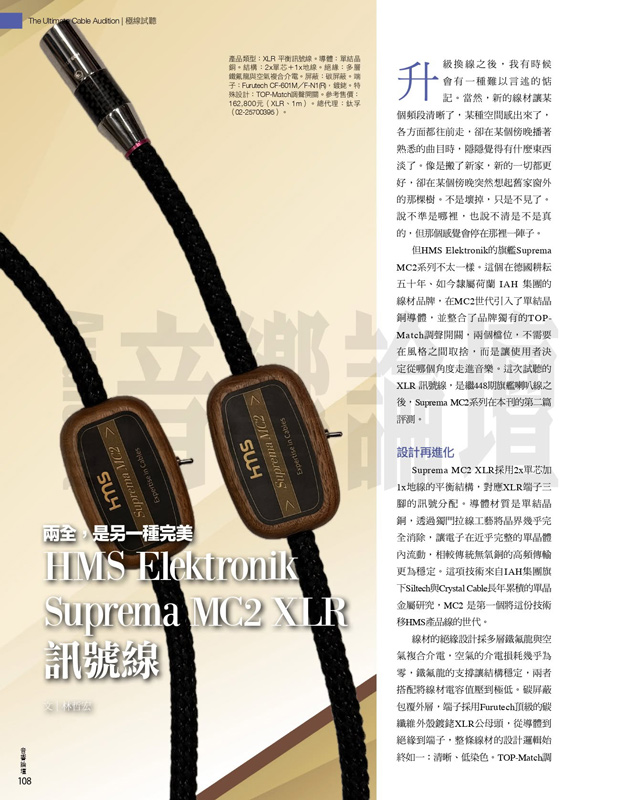
The Suprema MC2 XLR adopts a 2x single-core plus 1x ground balanced structure, corresponding to the signal distribution of the XLR connector’s three pins. The conductor material is monocrystalline copper, manufactured through a proprietary drawing process that nearly eliminates grain boundaries, allowing electrons to flow within an almost perfect single crystal—offering more stable high-frequency transmission compared to traditional OFC copper. This technology derives from the monocrystalline metal research amassed over many years by Siltech and Crystal Cable, both under the IAH Group; the MC2 is the first generation to transfer this technology to the HMS product line.
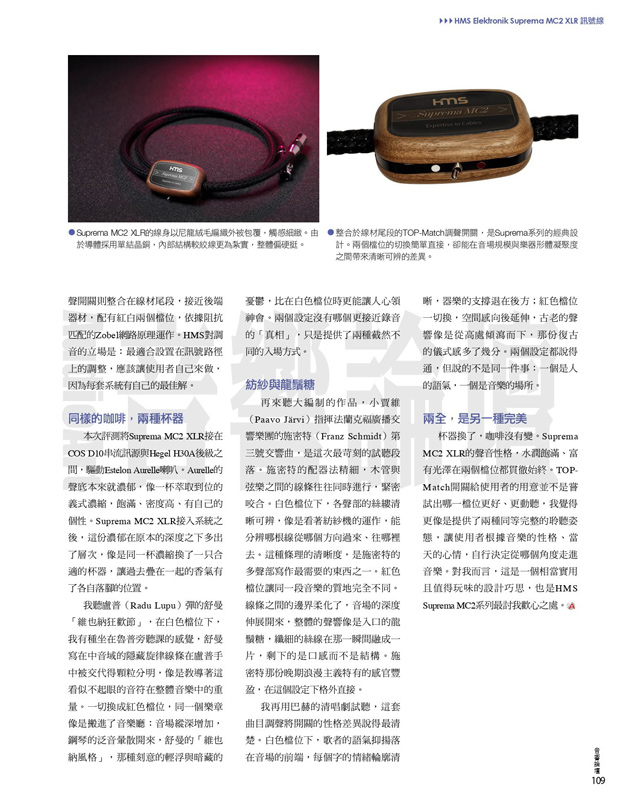
The cable’s insulation design employs a multi-layer Teflon and air-composite dielectric. Air has near-zero dielectric loss, while Teflon supports structural stability—together they keep the cable’s capacitance extremely low. Carbon shielding wraps the outer layer, and the terminations use Furutech’s top-tier carbon-fiber-shell rhodium-plated XLR male/female connectors. From conductor to insulation to terminations, the entire cable’s design logic remains consistent: clarity, low coloration. The TOP-Match tuning switch is integrated near the cable’s tail section, close to the downstream equipment, with red and white positions, operating on the principle of a Zobel network for impedance matching. HMS’s stance on tuning is that the most suitable adjustment point in the signal path should be left to the user, because every system has its own optimal solution.
The Same Coffee, Different Vessels
For this review, I connected the Suprema MC2 XLR between the COS D10 streaming source and the Hegel H30A power amplifier, driving Estelon Aurelle loudspeakers. The Aurelle’s sonic character is inherently rich—like a properly extracted espresso: full-bodied, dense, with its own personality. After the Suprema MC2 XLR was introduced into the system, that richness gained layers beneath its existing depth—like pouring the same espresso into a more suitable vessel, allowing aromas that once overlapped to find their own resting places.
I listened to Radu Lupu playing Schumann’s Carnaval de Vienne. In the white position, I felt as though I were sitting beside Lupu, attending a masterclass—the hidden melodic lines Schumann wrote in the mid-range were articulated with crystalline clarity, as if he were teaching the weight those seemingly inconspicuous notes carry within the overall music. Switching to the red position, the same movement seemed to relocate into a concert hall: soundstage depth increased, the piano’s harmonics bloomed outward, and Schumann’s “Viennese style”—that deliberate frivolity veiling melancholy—became more palpable than in the white position. Neither setting claims to be closer to the recording’s “truth”; they simply offer two distinctly different ways of entering the music.
Spinning Thread and Dragon’s Beard Candy
Next, I tested large-scale orchestral works—Paavo Järvi conducting the Frankfurt Radio Symphony Orchestra in Franz Schmidt’s Symphony No. 3—the most demanding audition passage this time. Schmidt’s orchestration is intricate, with woodwind and string lines often moving simultaneously in tight interlocking. In the white position, each voice’s thread was clearly discernible, like watching a spinning machine at work—you could distinguish which thread came from which direction and where it was headed. This level of textural clarity is one of the most essential qualities for Schmidt’s contrapuntal writing. The red position transformed the same music’s texture entirely. Boundaries between lines softened, the soundstage depth expanded, and the overall sonic fabric became like dragon’s beard candy melting on the tongue—those fine filaments dissolving into a single sensation, leaving texture rather than structure. Schmidt’s particular brand of Late Romantic sensory richness became more immediately palpable in this setting.
I also auditioned Bach cantatas, where the tuning switch revealed its character differences most clearly. In the white position, the singer’s vocal inflections sat forward in the soundstage—every emotional contour of each word clear, with instrumental support receding to the rear. Switching to the red position, the spatial sense stretched backward, and the antique sonority seemed to pour down from above, lending an extra measure of archaic ritual. Both settings made musical sense—but they weren’t describing the same thing: one was the human voice’s inflection, the other the music’s place of presence.
Both Complete Is Another Kind of Perfection
The vessel changed; the coffee didn’t. The Suprema MC2 XLR’s sonic character—lush, saturated, and lustrous—remained consistent across both positions. The TOP-Match switch isn’t intended for users to determine which position is “better” or more pleasing; rather, I feel it offers two equally complete listening postures, letting users decide, based on the music’s character or their mood that day, from which angle they wish to enter the music. For me, this is a highly practical and intriguing design flourish—and precisely what I find most endearing about the HMS Suprema MC2 series.