
1
2
3
4
5
6
7
8
9
10
11
12
13
A Dream Phonograph Cartridge Amplifier Built With 43 Switches|Thorens MC 1600
Review By: HIFI.DE
We’re not allowed to reveal who exactly developed the Thorens MC 1600. Instead, we’ll clarify how this phono preamplifier sounds – and what the deal is with its 43 hidden switches.
“Whether it’s an ambitious moving-iron, an affordable MM, or an esoteric MC cartridge: With the MC 1600, you get the ultimate sonic performance out of every pickup. The 43 DIP switches on the underside make setup tricky, but the many clever features compensate for that.”
For renowned turntable manufacturers, it’s a matter of honour to have a phono preamplifier in their range. And a proper one at that. It can be a bit more expensive, as long as it gives you the feeling that you’ll never have to think about this part of your system again. With the MC 1600, Thorens has introduced just such a preamp: fully balanced, MM and MC capable, extensively adjustable. And developed and built in Germany. Sure, you don’t just spend €2,200. Especially not if you bought an entry-level turntable and forgot that your amplifier doesn’t have a phono input. The MC 1600 is aimed more at people who already own a top-tier deck and want to push it even further.
Among Thorens’ own models, the TD 1600 is a predestined partner. The nearly identical name of the new preamp seems to underscore that. But a TD 1500 also pairs well with the – then equally expensive – preamplifier. Or the brand-new TD 404 DD. Or any other high-quality turntable, of course from other manufacturers too: The MC 1600’s extensive adjustment options ensure that it plays optimally with absolutely every pickup in the hi-fi world. We made ample use of this flexibility during our listening test.
Thorens MC 1600 Listening Test: Broadband and Dynamic
The fact that we equipped our Technics SL-1210GR2 for the listening test with the Thorens MC system TAS 1600 could be seen as a home-field advantage – also because the MC 1600 was developed and tuned, among other things, with this cartridge. But don’t overestimate the synergy effects: We use the TAS 1600 across all brands in all kinds of test situations simply because it’s an excellent, unpretentious, and very musical-sounding MC cartridge.
Conversely, we also listened to many other good pickups with the MC 1600, from Audio-Technica, Ortofon, Dynavector, Nagaoka, and Grado. Each of these cartridges not only retains its own style but even expresses it particularly clearly. This attests to the Thorens preamp’s high level of transparency and neutrality.
Straight out of the box, with only a minimal warm-up phase, the Thorens greets us with one of its special strengths: a bass range that doesn’t just rumble obediently but drives the music forward with plenty of elasticity and punch. Rock listeners will especially appreciate this. Even if a very high-quality preamp was playing before, after switching to the Thorens, the rhythm section of, say, Karate on “Pockets” gets a juicy extra boost.
But the lead guitar and cymbals also sound very lively and detailed. So the Thorens preamp isn’t just busy in the bass; it distributes its attention harmoniously across the entire audio band. Ultimately, the music sounds perfectly balanced, yet larger and more expansive than with most other phono stages.
Pleasant, Easily Accessible Sound
When you switch from a standard phono input or an inexpensive external phono preamp to the Thorens, the spaciousness and dynamics immediately confirm your decision: This investment was worth it. Meanwhile, we work our way down to ever quieter pickups: From the TAS 1600 with 0.4 mV output voltage, we go to the Denon DL-103 with 0.3 mV – and then to the Linn Klyde with barely 0.2 mV. This is a point where even high-end phono stages often reach their limits.
Our SPL Phonos Duo, for example, cannot avoid a noticeable background noise with such ultra-quiet MCs. On the Thorens preamp, by contrast, it’s barely perceptible. With moderately loud standard MCs, we often find ourselves thinking, after switching to the Thorens, that we’ve plugged into the wrong input because the familiar phono hiss is practically completely absent. As soon as the needle locks into the groove, the music is there – as if out of nowhere.
Pro with Bass and Details
But the SPL also has strengths – such as enormous dynamics and iron-fisted control in the fundamental and mid-tones. “(It Is) It Critical Band,” the great debut album by 90 Day Men from 2000, sounds even more rugged and multi-layered on that path. It makes you even more inclined to air-guitar along with the dissonant, rumbling post-rock chords.
Down low and up high, the Thorens has quantitatively more to offer, playing with nice pressure and detail. In return, the SPL delivers more speed, a more precise structure, and even more cleanly defined pitch. These characteristics remain when switching from MC to MM (Audio-Technica VM745XML) and MI (Grado Prestige Gold). In the end, the Thorens MC 1600 draws level with the SPL thanks to its broadband nature and its easily accessible, widely spread sound.
Two Channels, Four Signal Paths
The Thorens MC 1600 has a somewhat unfortunate name. Because of course it can also handle MM pickups very well. It offers moving magnet systems twelve selectable load capacitances between 50 and 600 picofarads and ten possible gain factors between 32 and 68 dB. The higher values are mainly intended for MCs. But you could, for example, combine a typical MC gain of 64 dB with a typical MM load impedance of 47 kilohms. Which actually makes sense for certain exotic pickups.
For the MC load resistance, there are a full 64 steps between 20 and 1280 ohms, providing ideal conditions for literally every moving coil, current or vintage.
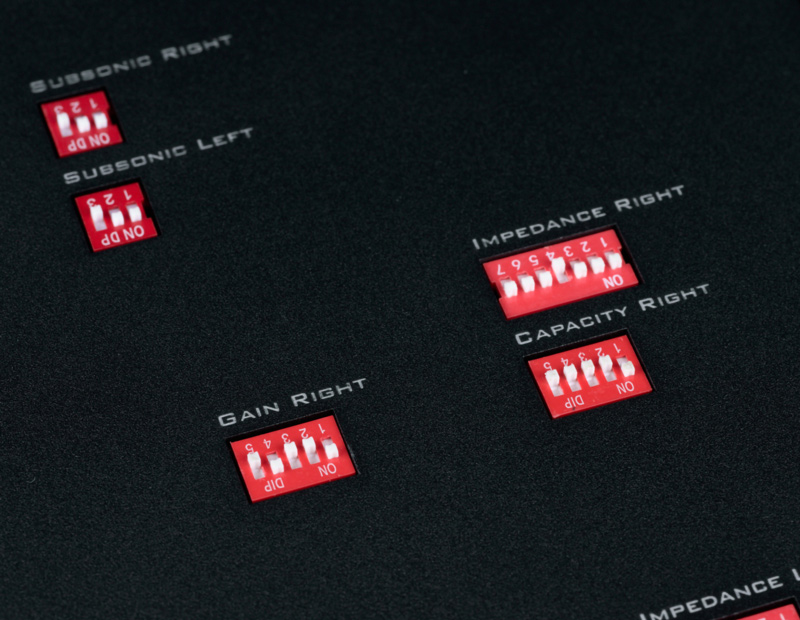
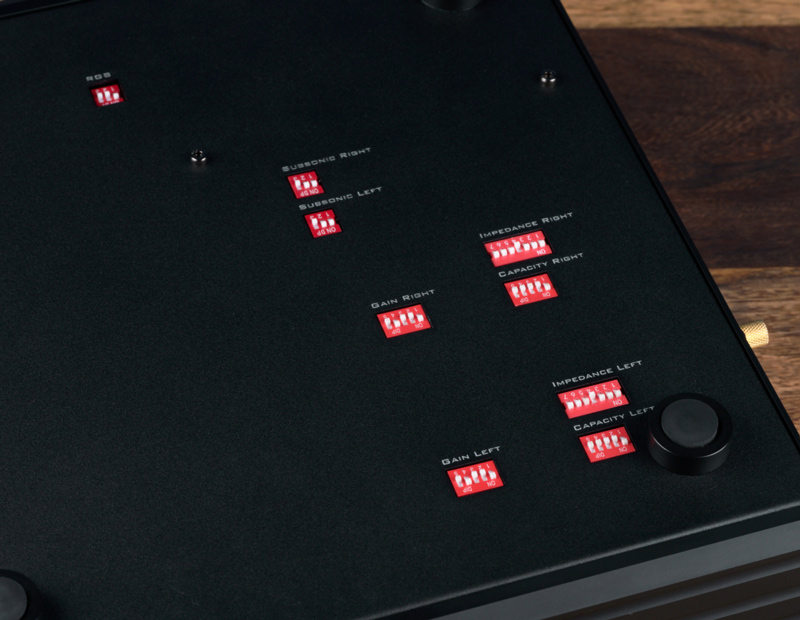
The MC 1600 is configured via a total of nine DIP switch banks (or “mouse keyboards”) accessible through the bottom of the unit. Seven miniature switches are responsible for the resistance, five each for capacitance and gain – always per channel. Of course, the same values should always be set for left and right. Precise adjustment therefore requires some diligence and well-filed fingernails.
That said, you don’t have to flip the phono stage over constantly like a five-kilo burger patty to make sonic decisions, say, between 100 and 200 ohms MC loading or between 50 and 100 picofarads MM capacitance. Because it sounds just as good lying on its back as it does right-side up.
Hard Shell from Taiwan, Soft Core from Germany
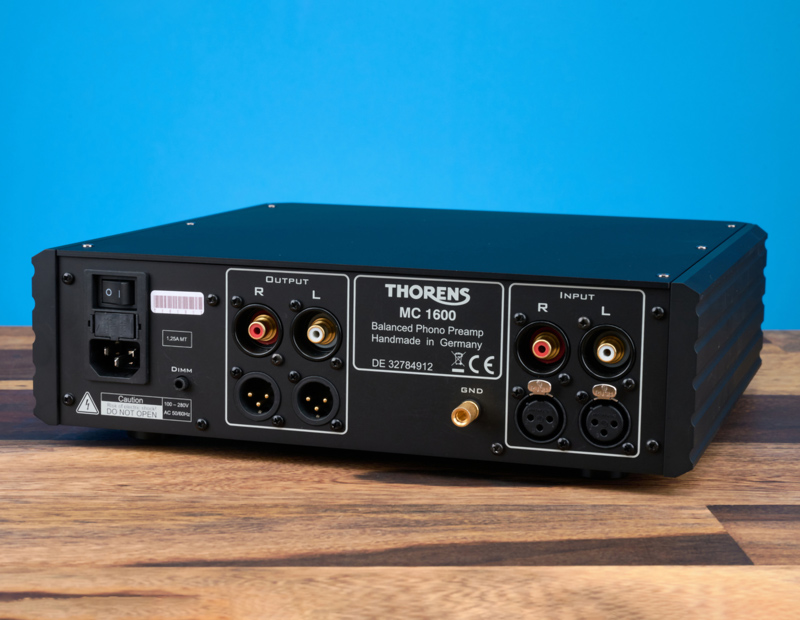
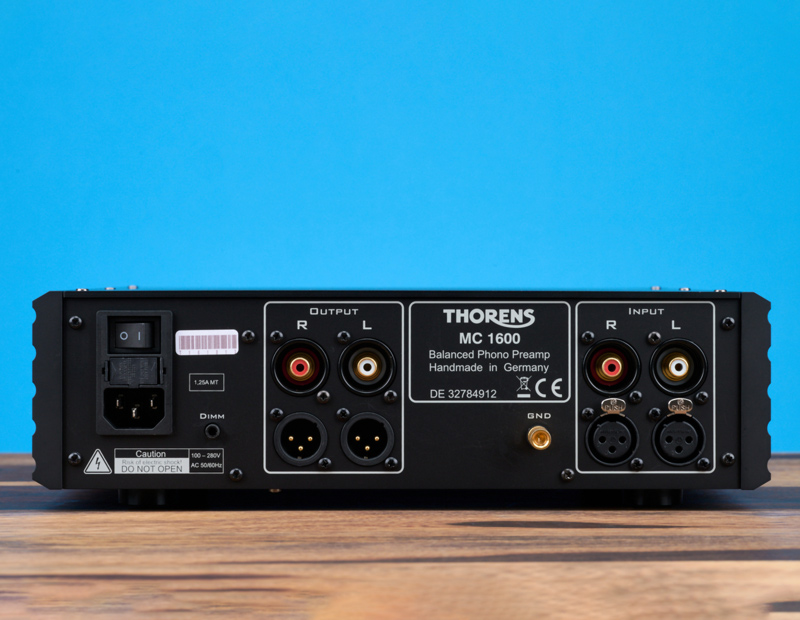
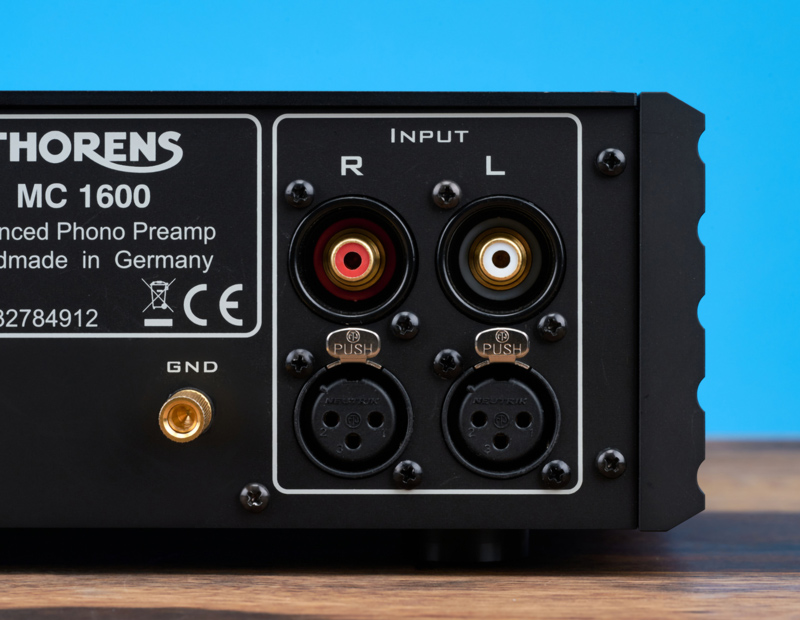
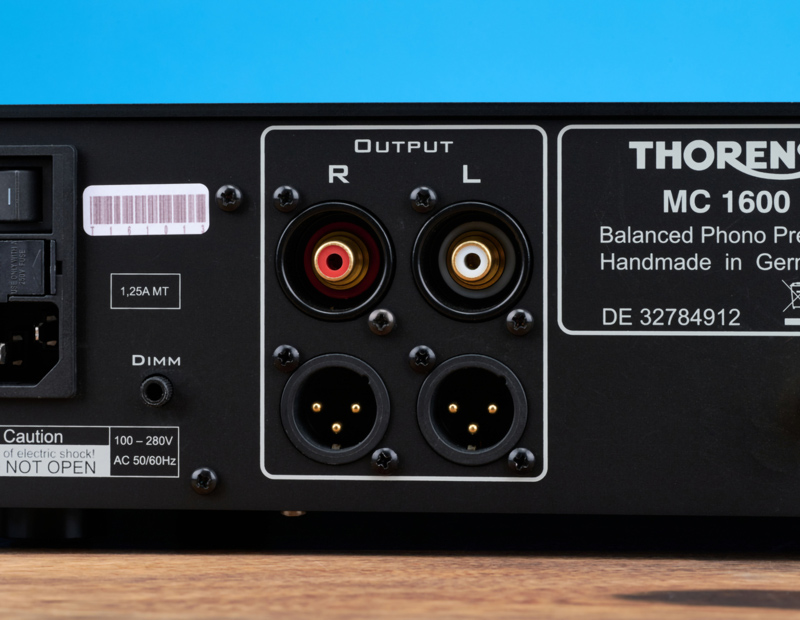
A two-stage subsonic filter can also be switched in. The higher setting filters out infrasound at an effective 12 dB per octave, thus protecting amplifier and speakers from acoustically irrelevant heavy lifting. Without useless cone fluttering, compact speakers in particular sound significantly better and can handle higher levels. The circuit of the MC 1600 is fully balanced from input to output. On the rear, you’ll find both RCA and XLR inputs and outputs, but you can only use one pair at a time.
SPL solves this more practically with a toggle switch that allows you to assign both input pairs to one turntable each. But that only interests owners of multiple decks and, of course, contributes to the significantly higher price of the Phonos Duo.
For the circuit development, Thorens cooperated closely with a traditional German high-end manufacturer that conveniently also has its own production capacities. So the MC 1600 is designed and made in Germany, with the friendly assistance of a Taiwanese specialist who mills and anodises the massive aluminium “Exhaustible” (chassis parts).
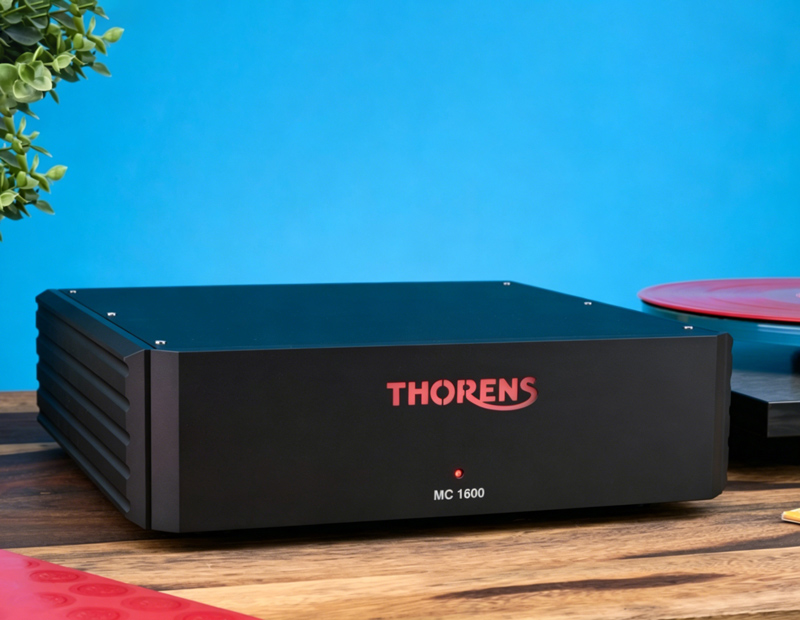
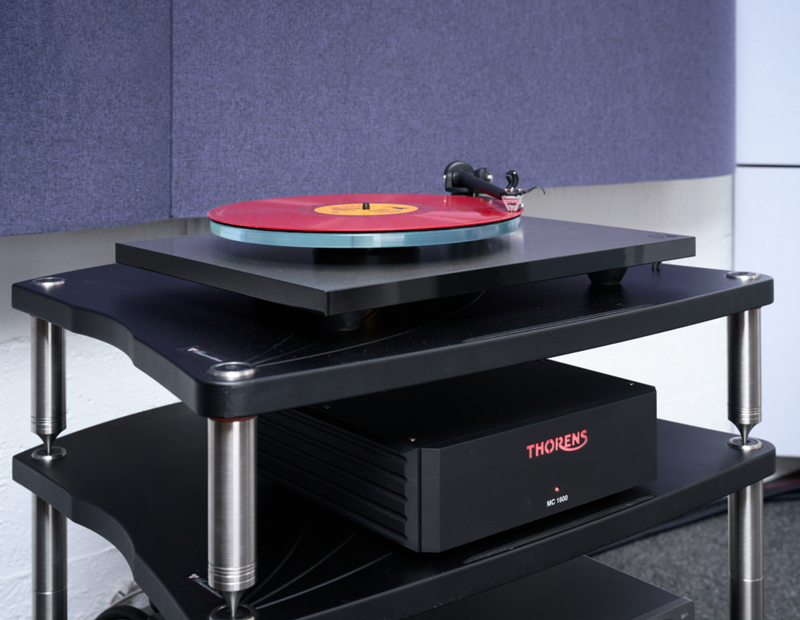
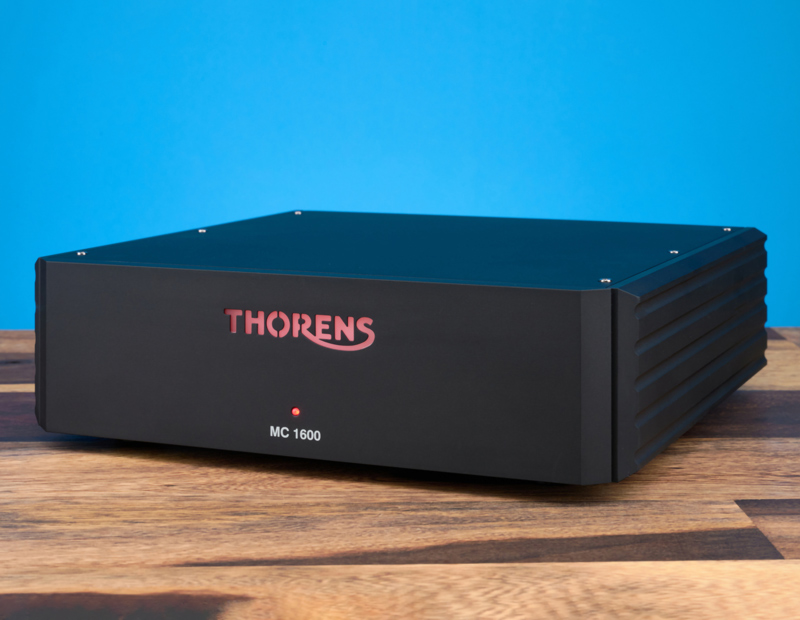
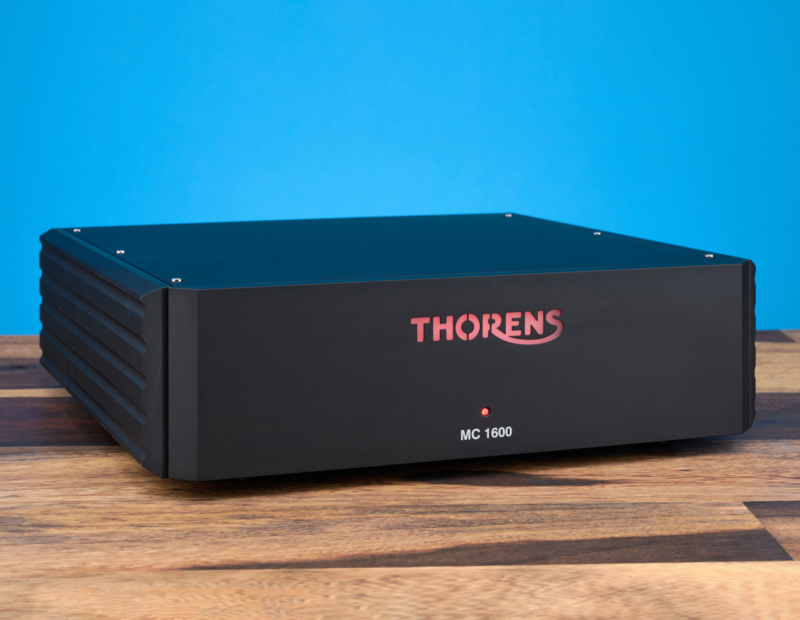
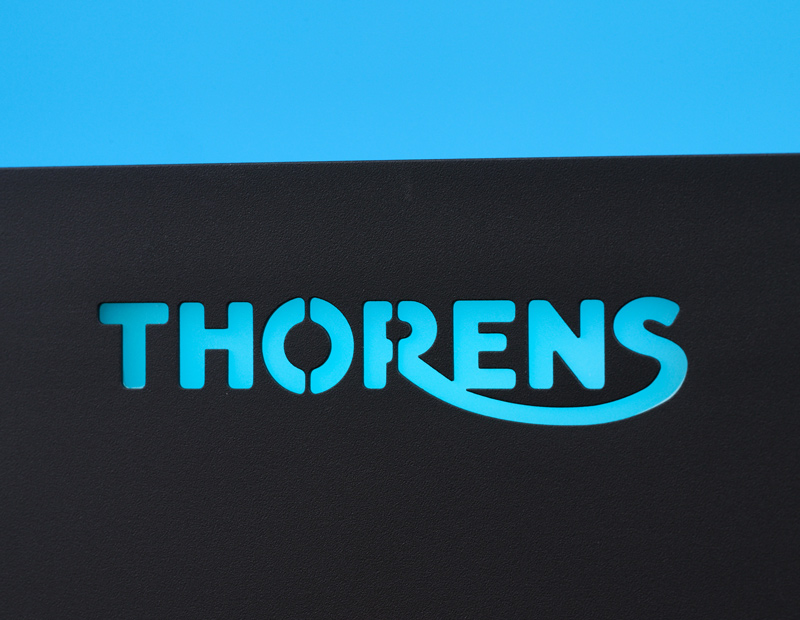
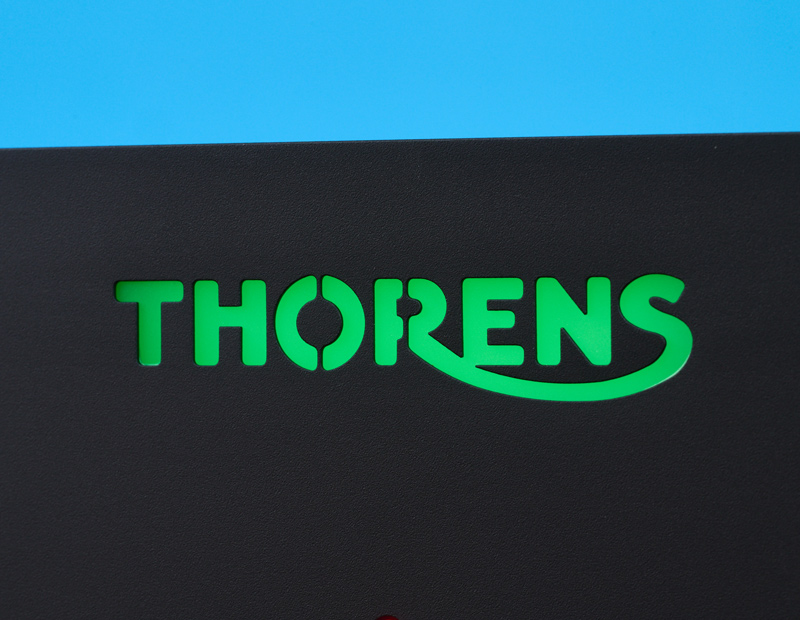
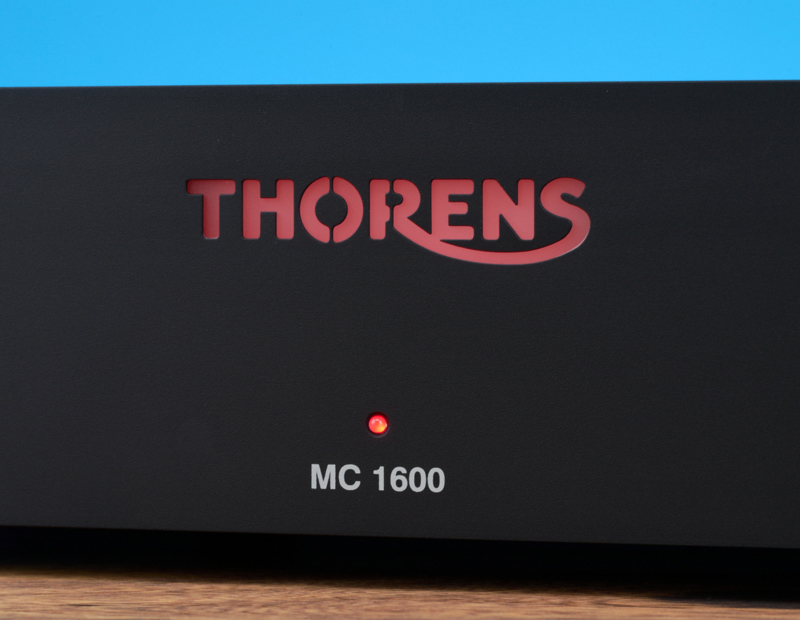
The design is once again the responsibility of Helmut Thiele, who also designed most of the new Thorens turntables. In the rack, the hefty preamp is hard to miss. This is also due to the proud Thorens logo, which, thanks to RGB LEDs, can glow in seven colours – also adjustable via DIP switches – and can be dimmed continuously with a rotary knob on the rear. For truly discreet enjoyment, you can also switch off the logo completely.
Practical Level Warning as a Hidden Feature
Always on and not dimmable is the red power LED. But it can do more than just glow red. Thorens has given it an additional task as a level indicator: When the amplified signal exceeds a predetermined value, the LED changes from red to blue. The developers set the trigger threshold so that over 10 dB of dynamic headroom always remains before the actual clipping point.
This is extremely practical. Because neither pickups nor the records themselves have any kind of standardised volume. Depending on the cartridge and gain setting, both overly “hot” combinations (which provoke unnecessary distortion) and overly quiet settings (where you waste dynamic range and signal-to-noise ratio) are possible. The simple LED ends the guessing game: If it occasionally flashes blue at loud passages without staying lit constantly, you’re right in the sweet spot.
The amplification in the MC 1600 takes place in op-amps, which, thanks to being socketed, can even be replaced. Because the circuit works completely symmetrically, each stage exists twice. So two extremely low-noise LT1115s receive the signals and pass the positive and negative halves to an OPA604 from Burr-Brown each. RIAA equalisation also takes place here, which consists of passive and active filters.
Towards the output, a total of four stereo op-amps of the type OP1655 follow, forming the balanced and unbalanced output stages. The circuit draws its power from two encapsulated switching power supplies, which reside together with regulation and filtering stages in the shielded right third of the chassis.
Our Verdict on the Thorens MC 1600
Very open and detailed, friendly in tone, and with juicy, punchy bass: The Thorens MC 1600 should perfectly hit the taste of many analogue fans. Once purchased, it can grow almost limitlessly with your player and system. No cartridge is too quiet for this very low-noise preamp, no connection value too exotic.
Technical Data
Inputs: 1x RCA (MM/MC), 1x XLR (MM/MC)
Audio Outputs: 1x RCA, 1x XLR
Load Impedances: 20–1280 Ω (64 steps), 47 kΩ
Input Capacitance: 50–600 pF (12 steps)
Gain: 32–68 dB (4 dB steps)
Dimensions (WxHxD): 300 x 90 x 300 mm
Weight: 5 kg