


Burmester 232: Relaxed singing, delicate violin playing, and rich, soft low frequencies.
Excerpted from ProLogis.com
Back in 2023 at the Munich Audio Show, Burmester had already launched the 232. The “232” refers to a product completed in February 2023, a consistent product numbering system for Burmester. Given that it was released in 2023, writing a review now is indeed late. But that’s okay; better late than never. Why the late review? Is it because the distributor hasn’t imported the premium audio equipment? In fact, in issue 435 of “Audio Forum” (December 2024), editor Lin Zhehong interviewed Eric Dubouays, Burmester’s Global Business Manager, who provided a very detailed explanation of this integrated amplifier.
Pending Certification
It’s a fact that the 232 hasn’t been imported yet, but the problem isn’t with the high-end audio equipment, but with Burmester. After announcing its release in 2023, they spent a lot of time modifying the internal firmware, resulting in the actual shipping date being 2025. I suspect they might be waiting for Tidal Connect, Qobuz Connect, Spotify Connect, and Roon certification, because if they don’t wait, they’ll have to wait for the next generation of integrated amplifiers to be compatible with these “Connects,” and these certifications have already been obtained. So, Burmester has really gone to great lengths. However, I still hope that the new products announced in 2025 won’t be available in Taiwan until 2027.
Regarding Burmester’s history, since I’ve visited the factory three times and previously written about it clearly on the “Audio Forum,” I’ll just briefly mention it here. As we all know, Burmester’s founder, Dieter Burmester (1946-2015), was not only an electrical engineer but also a bassist in a rock band. He loved music. Every time I visited his factory, I could see his collection of electric guitars. And although he’s a company owner and quite old, he still makes time to participate in rock band performances—truly a rock soul!
777: Starting a Business
Like many brand founders, he initially just wanted to make an amplifier for himself, but later, encouraged by friends, he entered the audio industry. In July 1977, he made a preamp for himself, which he named 777, and it was Burmester’s first product. He applied for a bank loan to start his business, but it wasn’t approved. Fortunately, his friends were very supportive and placed orders for the 777, so he founded Burmester Audiosysteme GmbH in 1978.
The 777 preamplifier looks somewhat like an industrial instrument, with handles on both sides, numerous knobs and levers on the panel, and two rows of LED indicators. This design looks outdated today, but it was quite novel at the time. I remember seeing a gold-plated version in the factory.
Then, in 1980, Burmester launched the 808 preamp, which remains its flagship model to this day. This preamp had two main highlights: a modular design and a completely chrome-plated exterior that was dazzling and eye-catching. The 808 has now evolved to its fifth generation, and its design from 45 years ago still looks modern and timeless.
Bespoke Series
After Dieter Burmester’s passing, Burmester was not acquired but continued by his widow, Marianne Burmester. From 2015 to the present, Burmester has shown no signs of fatigue or decline; on the contrary, it has launched many bespoke series and collaborated with other industries. For example, in 2023, to celebrate the 150th anniversary of silverware manufacturer Robbe & Berking, Burmester launched corresponding custom products. At the 2024 Munich Audio Show, Burmester commissioned five designers—Peer Kriesel, Dejoe, Ulrich Welter, Porsche Mambagrun, and Jan-Philipp Schuppe—to give the newly launched BX-100 different colors.
This year, at the 2025 Munich Audio Show, Burmester launched a custom product for the Porsche 911 Spirit 70 in a special “Olive Neo” color. This commemorative model will be launched in 2025, limited to 1,500 units worldwide, with a price tag of NT$13.33 million in Taiwan. “Olive Neo” simply means olive green. These Bespoke series demonstrate Burmester’s continued vitality and creativity. In addition, Burmester will also be launching the 249 preamplifier, 259 power amplifier, and 257 turntable at the 2025 Munich Audio Show.
Burmester’s current “regular” product line is divided into Signature Line, Reference Line, Top Line, and Classic Line, with the 232 belonging to the Classic Line. Among the integrated amplifiers in this series, the 232 is the newest model, outputting 150 watts per channel (4 ohms load). Other models include the 032 (4 ohms, 170 watts), 082 (4 ohms, 140 watts), and 101 (4 ohms, 120 watts).
The 232 is a “next-generation” integrated amplifier. It not only possesses the functions of a traditional analog integrated amplifier but also features preamp and subwoofer outputs. The rear panel has HDMI and ARC ports for connecting to a TV. It also has a Micro SD card slot and a USB port—basic features of a traditional integrated amplifier. Additionally, it can accommodate two expansion modules: a DAC module and a Phono module.
In fact, the 232 is a streaming integrated amplifier, but streaming music playback will only be activated after purchasing the DAC module. Furthermore, with the addition of a DAC module, it supports up to 32bit/768kHz PCM and DSD, and can also be used as a USB DAC, further enhancing its digital signal processing capabilities. The 232 can stream (compatible with Tidal Connect, Qobuz Connect, and Spotify Connect), is Roon Ready, supports Apple AirPlay 2, and has a built-in internet radio. Another module is the Phono amplifier module, which can play MC cartridges and has adjustable internal load impedance, including 33, 75, 220, 390, 1k, and 47k ohms.
App Control
However, the 232’s front panel only has one large knob; other controls are not visible. How can it be operated? This is why I call the 232 a “next-generation” integrated amplifier. All its controls are hidden, requiring a little learning before operation. Additionally, the Burmester Conduct App can be downloaded from the App Store for further control. Of course, the 232 also includes a remote control for familiar LKK audiophiles.
In fact, if you have your own streaming player, DAC, and phono preamp, the 232 is a standard traditional integrated amplifier. Simply connect your source to the 232, press and hold the large knob on the front panel, select your source input, and you’re ready to sing. At this point, the only difference between the 232 and a regular integrated amplifier is that the large knob can not only be used as a volume knob, but also display some functions on the panel by long-pressing it.
Minor Case Modifications
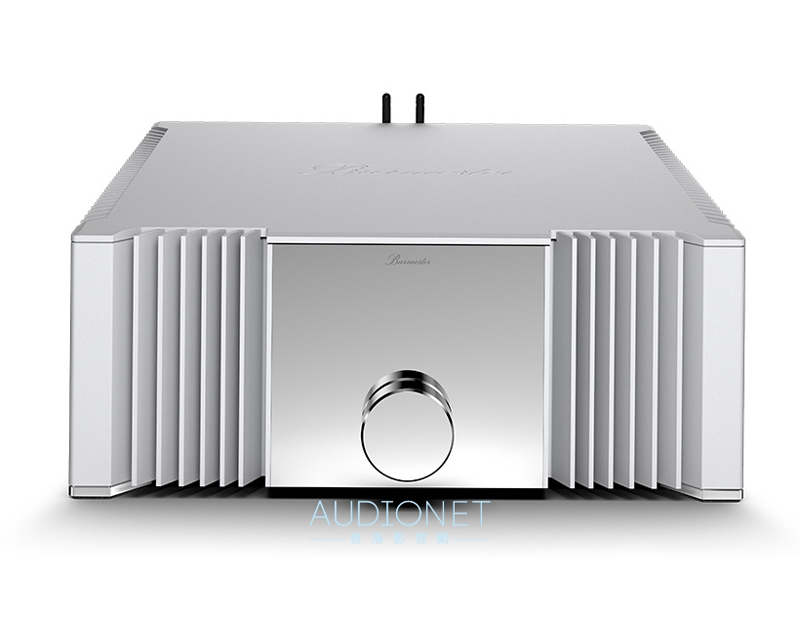
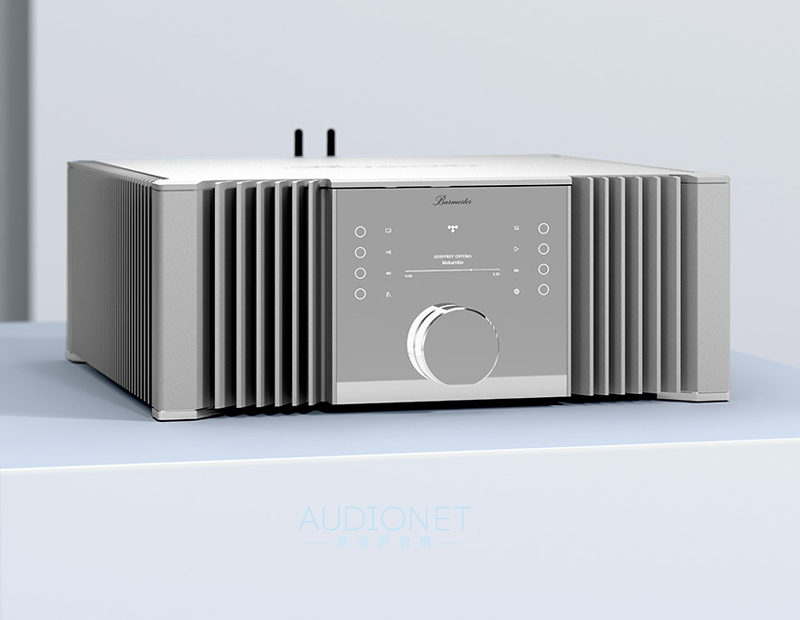
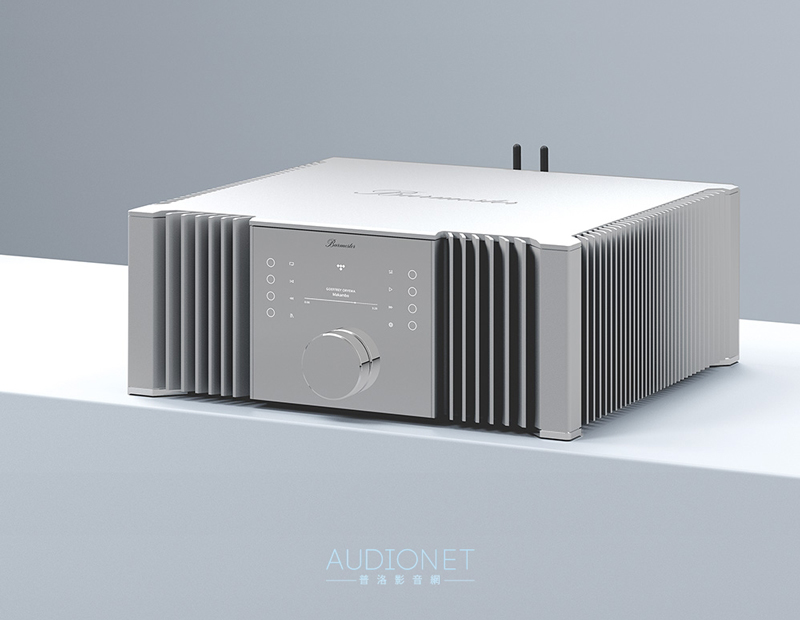
Let’s get back to the 232. I often say that Burmester’s case designs are truly classic; even after decades, they still look so avant-garde, so modern, so innovative, and never go out of style. Few manufacturers dare to extend the heatsinks from the left and right sides to the front panel, but the 232 does, and it doesn’t look bad at all. Upon closer inspection, you’ll find that the four corners of the case have been changed to cylindrical shapes, and the edges are rounded, effectively softening the case’s rigidity (previously, the heatsinks on the front panel extended all the way to the edges).
The 232’s case colors are now available not only in chrome but also in black, although the central area of the front panel is still shiny (black mirror finish). When the device is off, the front panel is completely black. Once powered on, you’ll find that the center of the panel is a display screen (not a touchscreen). The large knob, besides adjusting the volume, also has settings functions and serves as the power on/off and mute button (long press for on/off, short press for mute). This knob design is unlike anything seen in previous Burmester products.
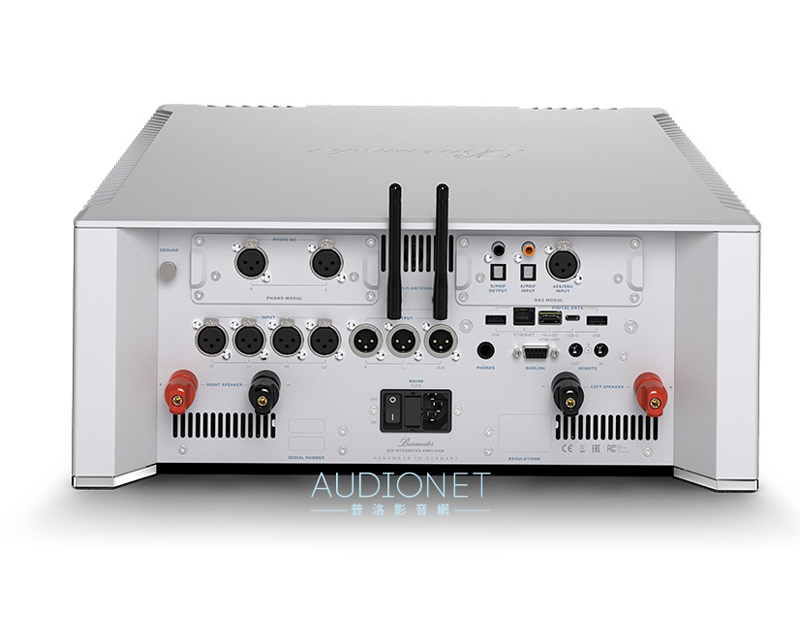
Note the European XLR connector. Moving to the rear panel, you’ll find there aren’t many terminals. The most prominent are a row of XLR terminals: two sets of XLR analog inputs, one set of XLR analog outputs (for using the 232 as a preamp, you need to go to the menu to set it to fixed or variable output), and one subwoofer output (also needs to be set to on/off in the menu). Sorry, Burmester does not provide RCA connectors. Please note that the balanced connector on the 232 uses the European standard: 1 ground, 2 negative, 3 positive, not the US standard: 1 ground, 2 positive, 3 negative. Do not get it wrong.
If your source XLR connector is US standard, you will need an adapter. Alternatively, if your source has phase inversion capability, you don’t need an adapter. Even simpler, you can buy a Burmester balanced cable, which will eliminate the phase connection issue.
Two Expansion Slots
In addition to the connectors mentioned above, the 232 also has an HDMI ARC connector, allowing users to connect a TV and have the TV’s audio output routed through the 232 to the speakers. In addition, the 232’s rear panel features three USB ports (two interfaces and one port), a network port, remote control input/output ports, a Burmester Link port, and a 6.3mm headphone jack. The 232’s headphone amplification circuitry is newly designed, resulting in improved performance compared to its predecessor.
Besides these ports, as mentioned earlier, the 232’s rear panel also has two module slots on the left and right sides, allowing users to purchase DAC modules and Phono modules (from the 077 preamp and 100 phono preamp). Note that the Phono module is only compatible with MC cartridges; MM cartridges cannot be used. I suspect Burmester assumed that those who buy the 232 would use MC cartridges, thus eliminating the need for an MM phono preamp.
If you have purchased a DAC module, you’ll see Digital Out (fiber and coaxial), Digital In (fiber and coaxial), and AES/EBU digital input terminals. Therefore, this DAC module is essentially a digital-to-analog converter, accepting streaming players without a built-in DAC, and can use CD players and other digital sources. Streaming functionality is actually built into the RS-232, but without purchasing the DAC module, the built-in streaming, internet radio, and Roon Ready features are unusable.
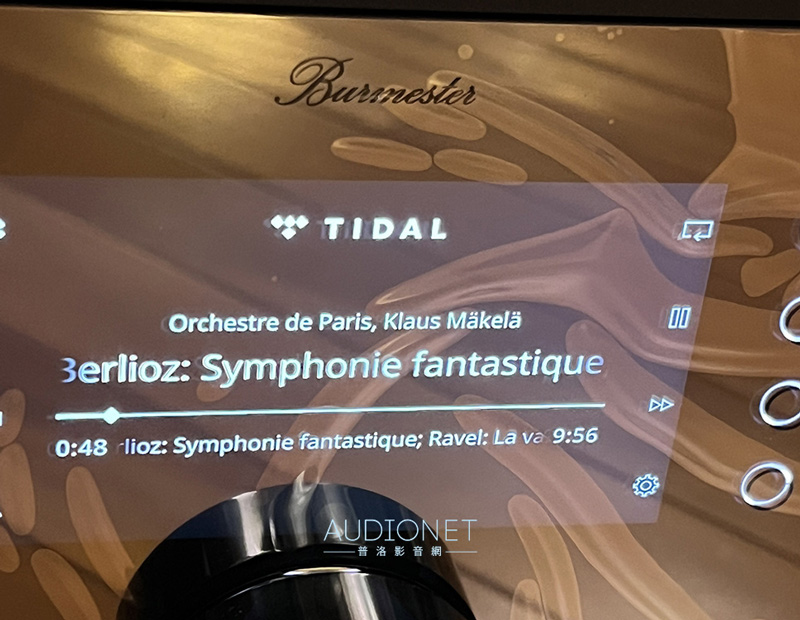
How exactly do you play streaming music using Connect? To use a Tidal, Qobuz, or Spotify app, while playing any track, tap the currently playing track. A speaker icon will appear in the upper right corner of the screen; tap it to view the connected devices. Select the Burmester 232 as the player, and you can listen to music.
Next, let’s discuss the 232’s settings. Like many modern preamps or integrated amplifiers, the 232 has several settings options. Tap the gear icon (tool icon) in the lower right corner of the screen to access the menu. The 232’s Settings menu includes six main sections: Device Settings, Source Manager (Inputs), Output Manager (Outputs), Messages, Maintenance, and About (Information).
Simple Setup
Device Settings is further divided into General Settings, which includes setting the username, device name (232), date and time (displayed when connected to the network; different time zones and 12-hour or 24-hour display can be set), Brightness (screen brightness), Display Timeout (setting whether the screen stays on or turns off after a certain time), Energy Saving Settings (setting how long after no signal input the screen will automatically go into Standby mode or remain powered on), Network Settings (displaying network connectivity), Network Information (displaying the IP address), IP Configuration (allowing you to specify a different IP address), and Network Setup (entering your network password to connect to the network).
In Input Settings, you can change the names of the input sources (it’s recommended not to, as it’s troublesome), adjust the volume of each source, select which source to prioritize, and remove sources (e.g., if you don’t have Qobuz, you can remove it from the list). These settings are optional.
In Output Settings, you can turn the speaker, headphone, or subwoofer outputs on or off. If you find that all the settings are correct but you can’t play music, the speaker output here might not be turned on. If your headphone jack is plugged into the headphone terminal, the speaker and subwoofer outputs will automatically turn off.
In Messages Settings, you can keep or delete messages. The Maintenance section doesn’t tell you how to maintain 232, but rather allows you to choose between automatic updates or turning it off. The 232 also features a Factory Reset function, which restores the original factory settings.
**Especially Powerful Power Supply**
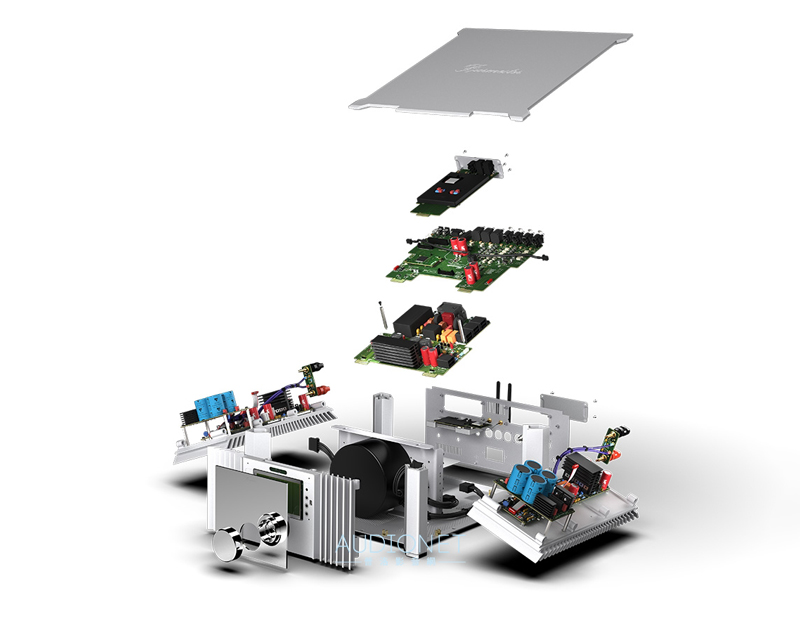
I didn’t disassemble the 232’s internals to avoid leaving marks. However, according to information provided to us by Burmester’s Global Business Manager in December 2024, the 232 has a dual-mono architecture, with wiring designed to resemble their 035 preamp and 036 power amp, essentially integrating these preamp and power amp components into a single enclosure. Its preamp inputs utilize new OP Amps, while the power amp inputs also employ new transistors, allowing for higher matching accuracy between NPN and PNP complementary power transistors.
Furthermore, engineers have focused on optimizing the power supply and power output stages. For power supply, the power transformer uses the latest high-end German components and draws inspiration from the 159 power amplifier design, using a single toroidal transformer with two windings (due to space constraints), effectively creating a separate power supply for the left and right channels. The internal software and firmware operate on a single-board computer module, providing Ethernet, Wi-Fi, and Bluetooth connectivity.
The display features small buttons.
The 232’s front panel lacks a traditional power switch. How does one operate the 232? First, plug in the power cord and press the switch next to the power cord. Then, go to the control panel and press the large knob. The red LED (Standby) light on the panel will turn green (indicating power-on). The previously black screen will then display a welcome message and the user’s name (if you entered one). Four small round buttons on each side of the screen will also appear, each with a corresponding icon. There is a gear (settings) icon in the lower right corner of the screen. These are your control and settings tools.
If you are connecting the source using XLR 1, please look at the bottom of the four small round buttons on the left. It will display a “library” icon with several lines. Press that button to enter the source selection menu. Turn the large knob to select XLR 1 (there is also XLR 2; the 232 only has these two analog inputs). Press the large knob (OK). You have now selected XLR as the source input and can start singing.
The 232’s design is very thoughtful; whenever you make settings or selections, the speakers will mute, and the display will show an “X” icon to prevent damage to the speakers. Actually, the Library is the source selection, which allows you to choose from XLR 1, XLR 2, Phono, TidalConnect, Qobuz Connect, Spotify Connect, HDMI ARC, Optical, AES, Internet Radio, AirPlay 2, and more. The 232 I tested doesn’t have Roon yet because it’s still awaiting certification; hopefully, it will be certified by the time you buy it.
Matching is crucial.
The listening environment for the 232 was my large open-plan living room, paired with two pairs of speakers: Dynamikks! Monitor 10.15 and AER Momentum. Both pairs of speakers have a sensitivity of 95 dB, more than sufficient for the 232’s 8-ohm 75-watt output. I must remind you not to underestimate these 75 watts; the 232 actually weighs a hefty 29 kg. It’s rare to see an amplifier with such a heavy output of 75 watts, unless it’s an Accuphase, meaning the 232’s power supply is exceptionally ample. Once the power supply is sufficient, even with only 75 watts, its ability to drive speakers is astonishing.
After comparing two pairs of speakers, I ultimately chose the DynamiKKs! to pair with the 232. It’s not that the 232 is unlistenable with AER speakers, but when the 232 drives the DynamiKKs!, the violin, piano, and cello are incredibly beautiful, completely lacking the aggression of horn speakers. This pairing result surprised me, so naturally, I chose the DynamiKKs!.
The Beauty of Sound Quality and Timbre
While the 232 isn’t Burmester’s top-of-the-line product, I believe its sound quality and timbre are not significantly different from their top-tier products. It’s also a fusion of various sonic aesthetics, and this fusion of aesthetics is precisely the 232’s biggest selling point. So, how does the 232 actually sound? The high frequencies are sweet and delicate; the mid-frequencies are spacious; the low frequencies are rich and elastic; the music is lively, lustrous, and full of detail, yet also crisp – these are my outstanding characteristics.
Its sonic beauty can be described as silky, creamy, and velvety. The timbre is a pale golden hue. The luster is like the morning sun, and the sweetness and crispness are like a Korean pear. As for the elasticity of the low frequencies, it reminds me of braised pork knuckles that are soft and chewy – saying “chewy” is an exaggeration, but it’s never soggy despite its abundance.
Delicate, Sweet, and Tender
The violin sound of the 232 is incredibly captivating. When I listened to Hilary’s rendition of Ferhans Williams’ “The Lark in Flight,” the violin seemed to transform into a lark soaring through the sky, embodying delicacy, sweetness, tenderness, and delicate beauty. The accompanying orchestral accompaniment was even more soothing and pleasant, truly possessing a velvety texture. Honestly, hearing such a beautiful violin and string performance was simply mesmerizing.
Then I listened to Angèle Dubeau’s performance of Philip Glass’s “Signature” (piano and violin). The violin’s tone was also beautiful, and the piano’s bass notes extended deeply and powerfully. Listening to her performance of “Mozart-Adagio” from Arvo Pärt’s “Portrait,” the violin and piano are both incredibly beautiful. Both instruments are mellow, sweet, and luminous, with exceptionally rich overtones. This exquisite instrumental timbre is a hallmark of Burmester’s sound, and the primary reason you pay a premium for it.
The entire piece is enjoyable to listen to.
Next, listening to Accardo’s Sibelius “Violin Concerto” (Colin Davis conducting the London Symphony Orchestra), the violin’s delicate, woody quality, sweetness, and luminosity are extremely soothing. The orchestra is vast and expansive, delicate and nuanced, with incredibly quick transient responses. Listening to the American Arts Trio’s performance of Tchaikovsky’s Piano Trio Op. 50 “Reminiscences of a Great Artist,” I didn’t feel tired at all throughout the entire piece. The tone and timbre of the piano, violin, and cello were all incredibly beautiful, and the harmonies were also exquisite. Such beautiful melodies and such beautiful sound effects—I could listen all day without getting tired! The saying that good sound quality comes at a price has been proven true time and again.
Listening to Pablo Ferrandez’s performance of Mendelssohn’s cello “Lied ohne Worte Op. 109,” the cello’s spaciousness, full resonance, and the woody beauty are also difficult to describe in words. Listening to Yo-Yo Ma and Emanuel Ax’s rendition of Beethoven’s Cello Sonatas in “Hope Amid Tears,” the crystalline sweetness of the piano notes is invigorating, and the solidity and elasticity of the keys are clearly audible. The cello’s woody character and rich, nasal tone are also very realistic, as are the subtle textures of the bowing.
Lively and Bouncy
Listening to the Emerson Quartet’s performance of Mendelssohn’s String Quartet No. 1, the most striking impression is its lively and bouncy quality. The strings of the four instruments seem to be bouncing right before your eyes, and the subtle details of the bowing are rich, the texture of the playing is incredibly realistic, and the harmony of the four instruments is simply beautiful.
When I listened to Bernstein conducting the New York Philharmonic in Mahler’s Symphony No. 2, the ample power supply of the 232 amplifier became apparent. Even in the high-tension passages, the 232 didn’t sound shrill or strained, maintaining a relaxed and composed feel. And when the music reached places with strong dynamic contrasts, whether in loud or soft passages, the 232 clearly presented the texture and layers of the inner voices. This ability to effortlessly control the overall musical composition is indeed something a typical 75-watt amplifier cannot achieve.
A Beautiful Gloss
When I listened to Karajan conducting the Vienna Philharmonic in Dvořák’s Symphony No. 8, the brass at the very beginning was brilliant and radiant, coated with a golden hue, displaying a beautiful tone. Then the orchestral tutti appeared, and the broad musical scale, the delicate high-pitched strings, and the subtly undulating low-pitched strings all made the music even more beautiful and moving. Moreover, the music seemed to be constantly enveloped in a beautiful glow, especially when the woodwinds played, the sweet and lustrous beauty of which was particularly captivating. Furthermore, the powerful energy and subtle details of Karajan’s conducting of the orchestra create a striking contrast, highlighting the exceptional transient response of the 232.
Relaxed Vocals
How does the 232 sound with pop music? The vocals aren’t overly voluminous, but rather moderate and relaxed, without sounding strained. When I listened to Woongsan’s “But I Love You So,” although it only featured steel-string guitar and vocals, the sense of space and the details of the vocals and guitar were incredibly rich. In addition, Woongsan’s voice is full and powerful, with penetrating force; the vocals don’t melt like ice cream.
Listening to Francine Thirteen’s popular “Queen Mary” again, the arrangement is simple yet powerful, especially the low frequencies. 232’s rendition is strong and focused, the electronic percussion effects are incredibly realistic and impactful, and the low frequencies have a truly massage-like effect.
Then, listening to Daisy Gray’s “Wicked Game,” the recording engineer deliberately created a large sense of space, with long vocal and instrumental trailing notes. However, this also allows 232 to reveal every detail within that spatial feel. Furthermore, 232’s vocal reproduction is beautiful, highlighting its value in sound quality.
The impact and clarity are both incredibly strong.
Let’s play another track, Chen Bozhou’s “Harvest Drum Improvisation.” I deliberately turned the volume up, and the energy of the drum array was truly astonishing. The sound didn’t distort at all; the drum’s elasticity, shape, clarity, and impact were all incredibly strong. This can’t be a 75-watt integrated amplifier! It sounds like it’s at least 200 watts or more.
The 232’s low-frequency reproduction capability is amazing. When I played David Chesky’s “Graffiti Jazz” album, many tracks have extremely low frequencies of 31 Hz. The 232 didn’t need an additional subwoofer to reproduce those low frequencies so smoothly, clearly, and with a focused quality.
Amazing Energy
Finally, I’ll conclude with the soundtrack from “Mission Impossible, Dead Reckoning Part One.” While not the ear-piercing, overpowering type, the underlying extremely low-frequency energy is frightening, and when the orchestral chorus reaches its climax, it makes you worry that the entire audio system might collapse. Therefore, I always carefully control the volume when listening to this music. This time, I was also careful with the volume, but the second time I listened, I couldn’t help but turn the music up even louder, because although the sound wave energy was astonishing, it seemed that the 232 and my speakers could still handle it. Honestly, this was practically a self-torture test, nerve-wracking, but it also confirmed its extraordinary nature.
First and foremost, exceptional quality.
The Burmester 232 is a superb new-generation integrated amplifier. Its true power cannot be judged by its 75-watt output; rather, its price point reveals its true capabilities. What I mean is: although it only outputs 75 watts per channel, its sound performance is in the million-dollar range, especially in the quality and timbre of musical instruments. Buying the 232, I can say this: it will absolutely satisfy you in the first of the “Twenty Essentials of Audio”—”sound quality”—and the other nineteen are practically a bonus.
Specifications:
Burmester 232
Product Type: Streaming DAC Integrated Transistor Amplifier
Release Date: 2023 (Actual Launch Date: 2025)
Input Terminals: XLR×2, RJ45, Wi-Fi, USB Type-A×2, USB Type-C, HDMI eARC.
Output Terminals: Speaker x1, XLR x1, XLR Sub x1, 6.3mm
Optional Modules: MC Phono Amplifier, Digital Amplification Module
Frequency Response: 10Hz-110kHz
Output Power: 150 Watts (4 Ohms)
THD+N: <0.0048% (1 kHz, 50W/4 Ohm)
Signal-to-Noise Ratio: >112dB
Damping Factor: >1000
Weight: 29 kg
Dimensions (WHD): 450×177×480mm
Key Features and Recommendations:
Key Features:
① Robust cabinet construction and classic design.
② Excellent power supply, driving force, and control.
③ Compatible with DAC and Phono modules.
④ Excellent sound quality.
Recommendation: Avoid pairing with speakers that have a very sunny or bright personality.
Illustrated 20 Essentials of Audio:
Sound Quality: 5
Timbre: 5
High-Frequency Sweetness: 5
Mid-Frequency Fullness: 5
Low-Frequency Solidity: 5
Soundstage Width and Depth: 5
Sound Density and Weight: 5
Transparency: 5
Layering: 5
Identification: 5
Musical Liveliness: 5
Imaging and Form: 5
Resolution: 5
Speed and Transient Response: 5
Vocabulary and Dynamics: 5